Introduction
Magic is everywhere. It does not hide in forgotten ruins: it flows through human blood, lights the streets, decides wars, and sets the price of gold. Everything that matters—a kingdom, a family, a god—holds its place through magic or against it.
This world's history has two eras. For nearly seven centuries, a man turned god held humanity through magic. For the last three, a colony of exiles resisted from a distant island. Then the god fell, magic returned to everyone, and the seal barring creatures from beyond fell with him.
Beneath the neighboring sea, Askenon's dwarves dig. They have no magic. They have gold, mithril, cannons, and a grudge against a god.
Chapter 01
The Known World
Cerberus is both an island and a city-state. Before humans arrived, only giants lived there. Exiles from the Ark built two capitals: Cerberus in the south, home of the Academy, and Vlad in the north beneath its hilltop castle. Between them lie green plains, forests held by packs of black wolves, and Mount Cerberus, where the Academy conducts its examinations.
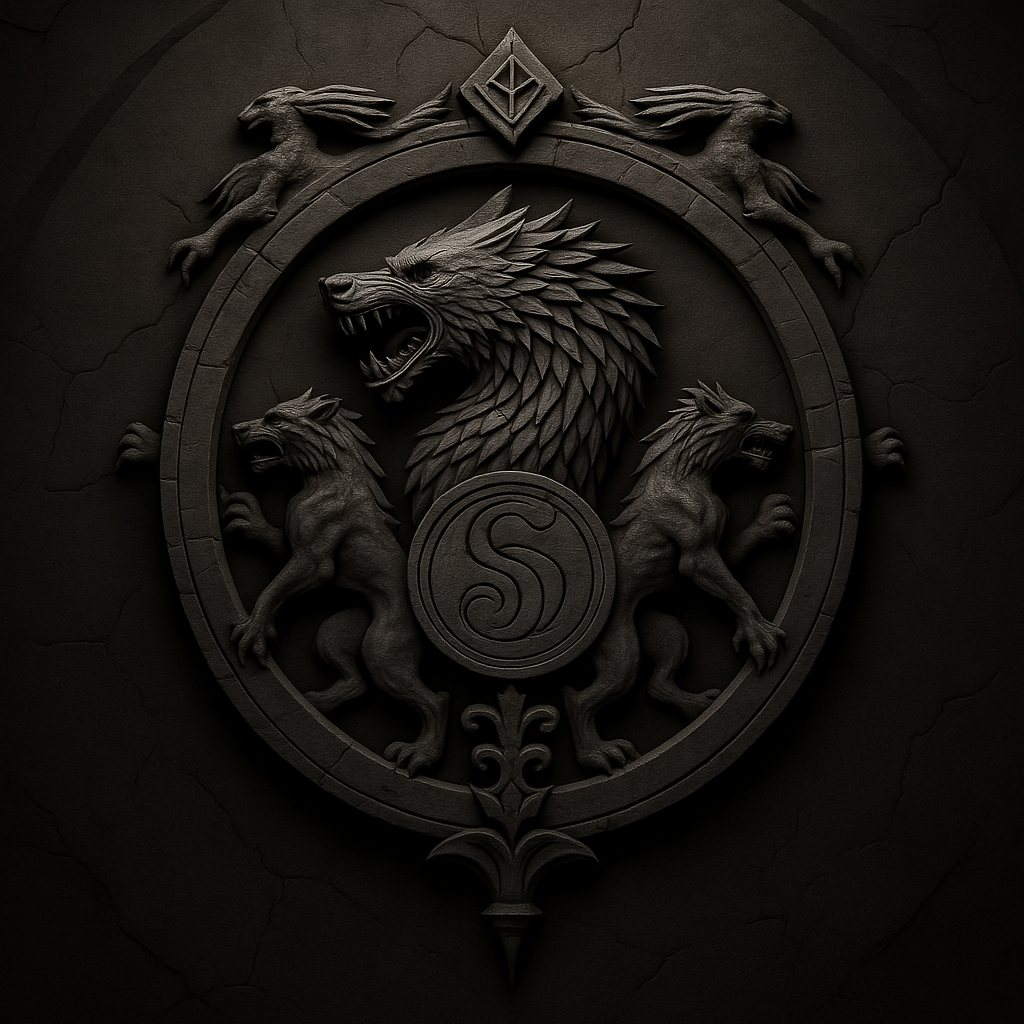
The country takes its name from its emblem, a mythical three-headed black dog called a Cerberus. Gold thread traces it on the sleeves of wizards' red and black robes.
Its uncertain frontiers release monsters: ogres, trolls, and especially giants whose resilience often defies spells. There are too few mages to cover the territory, and the State cannot defend further expansion. An adult White Dragon or Red Dragon is not a combat encounter but a political event.
This danger created a martial culture unknown in the Ark. The Knights of Cerberus ride the Cerberus horse, a black beast larger, stronger, and braver than any horse elsewhere. It breeds only on the island's plains, where the grass gives it its size. Knights and mages together drove back the ogres and giants. The horse became the country's first export long before magic; an adult can survive a Brazzant winter.
Beneath the island opens the Underdark, home of the drows and ingredients found nowhere else. Alchemists turn a great arachnid's gland, for example, into Spider Glue. Cerberans descend there knowing they are not alone.
The Ark is an archipelago of great islands and peninsulas—Telus Island, the Sylla and Crassus Peninsulas—surrounding the Central Ark. Each came to bear its censor's name. Its colossal waterfalls, white-marble palaces, impossible bridges, unfading roses, and singing fountains embody a civilization that believed a god would shelter it forever.
It counts four territories: the three censors' domains and the continent's marvelous central valley, rich in water and worked land. A circular aqueduct rings the valley, fed by four aqueducts, one from each territory. They carry grain, water, and the mana harvested by the Partage to the capital, which is also called Archon. There the aqueducts join into a single enormous vertical aqueduct that climbs into the cloud city where the god lives. The Ark's plumbing and the Ark's theology are the same structure.
The archipelago is closed by the Great Barrier: a curtain of water a kilometer across whose height no one has measured, standing between the Ark and the open sea. A censor opens it from a distance, and the water takes on his face for the length of the conversation. It is not the planar seal. The seal keeps out what comes from elsewhere; the barrier keeps out ships.
Brazzant is a cold island where the Ark long sent its exiles. Their descendants live in highland clans without schools or a magical system. Lamar, its main port, is a bartering settlement of huts.
Askenon is the dwarven world: several kingdoms built around great mines and, for most of history, never united. Kaz'Nakaram is strongest; Kaz'Baba holds mithril; Kaz'Valah holds gold. Traveling from Kaz'Nakaram to the Ark takes three weeks through snowy passes and rough seas.
Beyond lies a desert where Archon fought the red trolls. For that war he created Total Destruction, a spell that devastates an entire region.
Two languages matter. Humans speak Archon, named for their god—even Cerberan exiles kept the name. Dwarves speak Askenar, named for theirs.
Chapter 02
The Races of Cerberus
Four races now shape the known world: humans, drows, dwarves, and Jax. Race determines what a body inherits and how it naturally meets magic. A people determines what a civilization teaches that body to become.
| Race | Natural relationship to magic | Inherited traits |
|---|---|---|
| Human | Red mana throughout the body | Great physical variation and adaptability; lifespan near 100 years |
| Drow | Innate Psychic magic | Darkvision, great Dexterity, and racial powers; lifespan near 1,200 years |
| Dwarf | No natural red or blue mana | Extraordinary intelligence, constitution, Darkvision, and resistance to poison; lifespan near 400 years |
| Jax | Innate Psychic magic and Rift Sense | Telepathy, controlled descent, short-range teleportation; lifespan near 400 years |
Human
Every human carries red mana in the blood, organs, and every cell. This potential is the same in the Ark, Cerberus, and Brazzant. Their societies do different things with it; their bodies do not begin with different kinds of magic. Without alchemy or divine intervention, a human lives about one hundred years.
Untrained red mana sometimes emerges on its own. The rarest manifestations are Charisma spells; curses also appear without the person understanding how they cast them. Training makes magic repeatable, but does not create the potential.
The humans of the Ark live under the Partage. It harvests their red mana, transforms it, and returns a portion as stable divine power through Archon and his clergy. Divine magic is therefore a religious and political system, not a racial inheritance. Centuries of Republic came before it, leaving old beliefs, civic habits, family histories, and fragments of forgotten magic beneath nearly seven centuries of divine rule. The Ark's warm climate and food tend to produce leaner, more tanned bodies than Cerberus.
The Partage draws blood as well as mana. People who welcome it suffer no notable lasting effect and can live their natural century. Those who endure it through fear and chronic stress weaken and die younger. The Ark nevertheless offers divine care on a scale unknown in Cerberus, so its people generally enjoy better health and longer lives.
The humans of Cerberus preserve direct red sorcery. Their schools, great families, alchemy, verchoix, and Familiars exist to exploit the power every human already possesses. The first Cerberans came from a small group on Telus Island, leaving the island with less genetic variety than the Ark. Its temperate climate and different ingredients shape its people further.
The great families often marry among themselves. Their lineages preserve traits such as high intelligence that make magic easier to master, but ancestry does not set a ceiling. A gifted person from an ordinary family can still rise among the greatest sorcerers.
The humans of Brazzant possess the same mana but no organized magical tradition. Their differences are physical enough that some appear to belong to another race. Brazzant's cold, a diet rich in meat and milk but poor in grains and legumes, and centuries of marriage within clans produced distinct lineages. One clan may be known for red hair, another for exceptional height, strength, or speed.
A Brazzant child raised in Cerberus retains inherited tendencies, but food and environment change the body they develop. Human unions mix these traits normally; lineage creates possibilities, never a complete body or personality.
Humans have no racial Darkvision, innate spells, or unusual resistance to poison. Their racial advantage is possibility: the same human body can become a Cerberan wizard, a priest of the Partage, or a warrior shaped by Brazzant.
Drow
Drows are born with Psychic magic. They require neither a human formula nor a dwarven object to reach it. Their blue mana is stable, their powers need neither speech nor gesture, and their reserve returns through meditation rather than ordinary human rest. They possess no natural telepathy; speaking mind to mind still requires a Psychic spell.
Every drow possesses Drow Darkvision, without any weakness in daylight. Drows are generally more dexterous than humans or dwarves; only some Brazzant lineages rival them. Drow men are stronger on average, while drow women awaken Psychic power more easily because their emotions are stronger.
Racial powers always awaken in the same order: Levitate, Darkness, then Telekinesis. Age alone does not unlock them. Each awakening follows an experience that changes the drow: a death in the family, survival against terrible odds, a first love, or even a book that overturns an old belief. Drow institutions deliberately expose their people to risk and new experiences. A sheltered drow may live for centuries without progressing. In game terms, these awakenings are represented at Drow Levels 1, 2, and 4. They use normal blue spell slots and grant no free castings.
Drows become adults at eighteen and can live about 1,200 years. They age slowly through most of that span; frailty and visible old age come chiefly in the final century. They cannot have children with humans or dwarves, though relationships between the races remain possible.
Their bodies and magic belong to the Underdark. A drow recovers Psychic power twice as quickly below ground as on the surface, though never as quickly as a Cerberan human recovers red mana. Darkness is not merely where drows live. It is the environment in which their senses, magic, and doctrine become complete.
The known drows share one culture. Its history, the fall of Zaran Mor, and the families that survived it belong to the Drows chapter. Their racial traits under Polymorph are collected in the Drow template.
Dwarf
Every dwarf possesses an intelligence that would be exceptional in another race. A dwarf can master a mechanism, remember an immense system, and pursue a problem through more steps than most humans can hold in mind. Portin stands far above even this standard. Dwarves become adults at eighteen and live about four hundred years. Dwarven women do not grow beards.
Intelligence is not judgment. Wisdom is much rarer among dwarves, which makes them easier to manipulate than their brilliance suggests. Give a dwarf a false premise and they may build a flawless argument around it. Their civilizations suffer the same weakness: regulations solve one problem, produce three more, and remain in force because generations of intelligent officials can explain exactly why every line exists. Culture magnifies this weakness. A dwarf who lives among humans for long enough can sometimes learn to think more flexibly and exercise better judgment.
Dwarves have the same Darkvision as drows and a constitution superior to that of humans. They need less sleep, can work twenty hours a day without considering it extraordinary, and resist poison far better than humans or drows. Their resistance to Valerium is greater still.
Dwarves cannot naturally wield red or blue mana. Their civilization learned instead to draw magic from metal, stone, and the world through runes. A human could probably learn the same process, but doing so would require a strange investment of decades when red mana already waits inside the human body. For a dwarf, runes are not an inferior alternative to sorcery. They are the great magical path their race built for itself. The Monk of Kaz'Nakaram is an exception created by a Valerium implant; its blue mana comes from the implant, not the dwarf's body.
Runes, castes, Valerium implants, engineering, and the kingdoms built around the great mines are cultural achievements rather than instincts. They belong to Askenon and the Dwarves. Differences between Kaz'Nakaram, Kaz'Baba, and Kaz'Valah are cultural rather than racial.
Jax
Jax are tall, elf-like humanoids from the planet Salk. They possess blue mana and live about four hundred years. Their natural Psychic powers awaken in a fixed order: telepathy, Feather Fall, then the personal short-range version of Teleport. These are racial awakenings rather than the full extent of Jax magic. More powerful Psychic spells require study.
Every Jax possesses Rift Sense. It perceives Psychic beings and sources, including across dimensional boundaries when strengthened by a collective ritual. It does not perceive red mana. A human therefore appears magically empty to this sense, even when that human is a powerful sorcerer.
Jax telepathy does not make their minds communal. Entering the mind of a free Jax without permission is a grave breach of trust, and mental domination is treated even more severely. These protections end at the boundary of status: Jax law permits both telepathy and domination against slaves.
The Jax are one race and one conquering people. Their ranks, marriages, expeditions, and first interest in the drows belong to the Jax of Salk chapter.
Chapter 03
Manatar, Archon, and the Birth of Magic
Before humanity as it is known came Manatar, a creator god who reshaped humankind. He gave humans red mana, harmless and inexhaustible in their blood, organs, and every cell. The first humans used it instinctively: anger or grief produced a spell they could not repeat.
Archon first built a system. His method reproduces spells through precise steps: speech, movement, and above all visualization. It demands concentration and years of study available to very few. It remains the magical system of humans in both the Ark and Cerberus.
Archon worshiped Manatar fanatically, and Manatar gave him eternity.
Archon established the great schools of Conjuration. Remarkable families took charge of other fields: the Stonehearts of Abjuration, Leblancs of Divination, and Alois of Transmutation. For generations these minds worked together, and the system grew with their power.
Cerberus mages describe mana as a cloud of chaotic particles drawn by a force still not understood. A wizard manipulates those within and more readily influences nearby ones. Blood contains far more than the rest of the body, but only alchemy can exploit this.
Mana particles arise and transform, sometimes becoming elemental particles. Over immense spans of time, all life decomposes into magic.
Above all, they retain information. Each remembers places crossed, spells fed, and lives touched, endlessly replaying versions of the past like elders repeating a familiar story at market. Divination reads that memory, and an ambitious enough spell can write into it.
This defines each school's nature. Evocation turns magic into temporary elemental energy. Conjuration creates matter, sometimes permanently, and erases the history stored in its particles, making it useful to anyone avoiding Divination. Illusion shapes figments that become tangible when fed readily available but less solid Shadow Plane energy. Transmutation changes creatures or objects, though its spells are not all compatible. Enchantment acts on minds, including the caster's. Necromancy handles positive and negative energy and is rarely taught. Universal magic combines every school and is therefore weaker than a specialized spell of the same level.
A magometer, enchanted with powerful Divination, measures the magic in an object, enchantment, or mage. It becomes unreliable against extremely powerful enchantments whose magic is too complex to read.
Chapter 04
The Ark
Before the Partage, the Ark was one Republic. Its Senate sat in Aventia, the oldest territory beyond the Central Ark. Tyrena, the central island, and Cato, the eastern peninsula, joined it later. Each territory kept its own governors, families, and interests, but sent senators to Aventia. This was the Golden Age of Wizards. Sorcery gained ground against the old religions while corruption and struggles for power fractured the Republic. In the Central Ark, an eccentric hermit named Archon lived in seclusion, obsessed with his research and gathering his first disciples. No one expected him to become a god.
Then Archon activated his epic spell: the Partage. Thousands of innocents died. Among them was the family of Gérard Alois, who rebelled, left the Ark, and led his people to a distant island.
The Partage harvests the mana of every human in the Ark and gives it to Archon. That mana grants him the power of a god, and he claims the title.
For an ordinary person it arrives as weather. Every seventh day a chasing rain falls across the whole territory of the Ark. The water hunts down man, woman, and child; there is no roof and no altitude that stops it. It forces itself into the body through the mouth, the nostrils, the eyes, and for a few seconds the victim is drowning. Then it leaves, carrying off a quantity of blood and the whole of that person's magical potential. Mana returns on the morning of the next rain, and is taken again. Resisting is possible and pointless: the water gathers itself into elementals and fights for its share.
Seen closely, the Partage is not a tax. It is a ritual in which a person sacrifices both mana and life force to Archon or one of his servants in exchange for powers or blessings. A person can submit to Partage through a censor just as they can through the god. In Cerberus, the word itself is taboo. Archon converts this power into mana of his own design: divine mana, golden in appearance but transformed from human red mana. Nearly seven centuries of rule follow.
Divine mana is more stable and easier to wield than red mana. It heals directly, while the people of Cerberus must rely on alchemy. It supports fewer spells and functions poorly beyond the Ark's territory. Above all, it makes magic accessible to minds unsuited to study. A soldier of the Ark can wield a complex spell that a Cerberan wizard would need ten years to learn.
The cult has weapons of its own. Archon's priests favor the trident. A knight of the Ark marks targets with sanctified gloves, then calls Divine Judgment upon them. Water reserved for the god transforms the knight into an Emissary of the Ark, a gargantuan, winged version of themselves. A priest can inject that same water into an open wound, tear away an enemy's mana, and offer it to the god. A devotee may ask for a favor, though few are granted. Sanctified wells and fountains form a teleportation network.
The Rendered
Some of Archon's fanatics willingly sever a limb to demonstrate their complete obedience to the Partage. Divine water replaces the sacrificed limb. It is stronger than flesh in battle but remains a disability in nearly every other part of life. For a priest, who is not primarily a warrior, the exchange is rarely favorable. Most importantly, the limb stops working whenever its bearer is cut off from the Partage.
Archon dislikes the practice but tolerates it. The Ark punishes it because maintaining a limb of water consumes the Partage's power, while ordinary people receive no such privilege when they truly lose an arm or leg.
Some Clerics and knights may receive a water limb after an injury. Fanatics exploit this exception by mutilating themselves, then lying about the cause of the wound to obtain what the Partage would otherwise deny them.
These people are called the Rendered. This is neither an order nor a rank; the term describes anyone who has rendered part of their flesh unto Archon. Waterlimb is a colloquial and often less respectful alternative.
Archon grants blessings himself or delegates them to his censors, the great lords of the archipelago under the god. A paladin blessed by Archon in person knows it and makes sure everyone else does too.
The clergy measures its hierarchy differently from magistrates. A title defines what one is responsible for, not what one is worth. The bearer carries bloodied water to the center. The pourer conducts the rite. The fountainkeeper maintains a well and the faithful who depend on it. The curator of waters answers for a temple, its channels, and its officiants. The network steward answers for a city's waters. Above them stands the censor—the only office the cult took from the Republic, still performing the same work: counting the people and judging the morals of a population that surrenders its blood.
Among themselves, the faithful do not speak of offices. One is thirsty while the Partage grants nothing, watered when a share arrives, irrigated when that share is comfortable, a confluence when redistributing it to others, and a source when the network supplies enough that others come to them as they would to a well. These terms are never written down and are often spoken behind people's backs.
A few high-ranking priests are not harvested. They retain their red mana and receive a single task: convert Cerberan spells into divine liturgies. The work takes years, sometimes an entire lifetime for one formula. Through it, the god's catalogue grew far beyond Archon's own knowledge. These priests are the last people in the Ark who still possess magic of their own, and they possess it only on loan so they can build magic for everyone else.
Archon did two other things whose cost the world would understand only after his death.
He sealed the plane. Powered by the Partage, his planar seal did more than block creatures from elsewhere like a wall. It detected them, seized them, and actively returned them to their home dimensions. While it held, the world remained closed.
He also divided himself. With Soul Odyssey, he created an avatar, Polymarch, and lived a second life among humanity without anyone knowing. The spell had the property Archon desired above all others: his avatar could travel back in time. He wanted to meet Manatar. A flaw prevented it. A being of his power was rejected by the world's memory as a body rejects an incompatible organ, and he had to abandon the dream.
To the Ark, Cerberus is not a country. It is a colony of traitors whose sons are as treacherous as their fathers.
Chapter 05
Vlad Varanov and the Founding of Cerberus
The State of Cerberus was born from a refusal.
Antoine de Cerberus was a noble paladin of Archon. He opposed tyranny and chose freedom, an act remembered as the Great Refusal. Conviction alone could not found a country capable of standing against a god. Antoine made a pact with the most dangerous creature in the world and Archon's most bitter enemy: Vlad Varanov, the first vampire.
The Ruin of the Varanov
The Varanov were merchants on Tyrena, rich, ambitious, and not satisfied. A censor's word could take money away; it could not take magic. Vlad meant to make his house a house of wizards, and the whole family worked the receptions of the island's wizards looking for a patron.
Commode Telus, second son of the censor Markus Telus, was brilliant at politics, at war, and at magic, and the youngest senator in the Ark's history. He was also rotten all the way through, and careful about it. He offered his patronage to Vlad's daughter Anastasia, the best of the family at that game, in exchange for a few merchant services. The Varanov thought they had found a son-in-law: elegant, powerful, and the censor's own son.
Anastasia became pregnant. Commode had never meant to marry a merchant's daughter, and a child would have made him. He killed her in her own house.
She did not die quietly. Knowing at last what he was, she laid a desperate curse on the child she was carrying: kill your father, and every Telus after him. The child came out of her already obeying. It should have been named Tiberius Telus. It had the head of a bull, and it went for the one man in the room it had been born to kill.
Commode very nearly died there. Every enchantment his father had bought him counted for nothing. He called for help, and a paladin came down out of the sky: Antoine de Cerberus, who healed him and fought the creature. The Minotaur was running on instinct, recognized an opponent it could not beat, and walked out through a wall. Anastasia's mother, Anna, found what was left of her daughter.
Commode had Vlad blamed for it. Vlad attacked him with everything he had, which amused him. Commode confessed the whole of it to his face, told him the family should have stayed merchants, had him arrested for the assault, and bribed the diviner assigned to the case. Vlad was condemned, and Anna took her own life.
The Censor's Silence
Antoine had seen the room: the mother torn open, the newborn going for one man and no other. He carried it to Markus Telus. Markus stopped trusting his own advisers and investigated the affair himself. What he found was his son.
He did not make it public. Overturning Vlad's sentence would have meant naming a Telus, so the sentence stood. Antoine watched the Ark's justice send an innocent man to the scaffold to keep a censor's name clean, and that is where the paladin's loyalty broke.
Once the scaffold had failed, Markus put Commode in the lighthouse prison, then banished him to Brazzant aboard the Victis Moralis—as much to keep him away from the vampire and from his own son as to see justice done.
Commode survived Brazzant, which says everything about him. He founded a clan, fathered a great many children, and discovered two things: that his manipulations meant nothing to barbarians, and that a clan chief was stronger than the Minotaur on a diet of meat and fighting. When word reached him that Vlad Varanov and Antoine de Cerberus had fled with the mage houses to settle the island of giants, he took the name Telix and began preparing a return.
He never made it. A man in a Cerberan robe came to the village to collect Brazzant turns of phrase for a book he was compiling. He could not cast a spell as far as anyone could tell, and after a few days Commode decided to strangle him. His hands turned to stone on the man's throat and the floor came up through his chest. Most of the clan died attacking afterward. The mage put the barbarians' children on his ship and sailed for Cerberus. Those children are where the Psychic Project got its raw material. The curse never reached its first target: the Minotaur's father died on Brazzant, at another man's hand.
The Scaffold
Vlad Varanov stopped eating and drinking in his cell, and a week later he was brought out to be beheaded in public. Asked to repent, he cursed himself instead. He had been doing an accountant's sums for a consul while his family was hunted through his own house.
A completely untrained person driven far enough past the end of hope can cast a desperate curse—a high-level spell, permanent, undoable only by a powerful Abjurer (see the section on becoming a wizard, below). Grief is the only training it requires, and Vlad Varanov had been taken further than most men are taken.
The axe came down and the head stayed on. It came down again, and again, to no effect. Vlad turned around to look at the man swinging it. He was hungry.
He killed without counting that day and drank what he killed. The censor ordered him hunted and learned that the thing his family had made was more than a censor could put down.
He did not return as a man. He returned as a predator and haunted the nights of those who had condemned him. That was when Antoine de Cerberus came looking for him. He had saved the man who destroyed the Varanov and watched his own order execute the one it had wronged. He saw an ally rather than a monster to destroy: two rebels fleeing the same tyranny to build a new world.
The first years were brutal. Mighty giants roamed the island and attacked without mercy; there could be no dialogue and no peace with them. The population survived in a refuge carved into Mount Cerberus while the powerful brought back food. Expanding the frontier took long years and everyone's effort. Only then came the cities, farms, and families.
Then Antoine de Cerberus disappeared, and Vlad Varanov was crowned king.
Archon had let the rebels go for a price, and the price was Antoine. You think these people can do better than the Ark? Then watch them. Do not intervene. You will see their true nature, and you will miss the Ark. The bargain has no term. It ends the day Antoine says he misses the Ark, and Archon has all the time in the world to wait for it. Archon's death does not end it either; a paladin keeps his word. The paladin kept his human form and the divine gifts that let him vanish or wear another face, and he has been watching ever since: present at everything Cerberus has done, forbidden to stop any of it.
His reign was long and sometimes bloody. Vlad was tall and thin, with white skin, red eyes, and fangs. He could kill a giant alone and move faster than a runic warrior could follow. The northern city bears his name. His castle dominates its hill. His knights and units protect the villages from ogres, while Psychics and elite units handle the giants. His adviser Gaspar collects taxes while chanting aloud: another five hundred coins for the master. His alchemist Vorac experiments in the castle dungeons, where prisoners are bled for the master.
One day, the mages rebelled. This was the Great War of the Mages. Vlad Varanov had allowed the great houses to live under his protection, and he saw only betrayal in their plot. He entered the Stoneheart home, broke their Barrier and their door, and killed their guards one by one. He tore the infant Lucius from the arms of the dwarf Kaskad, slashing Kaskad's throat for drawing a weapon in defiance of his caste's code, then bit the child. A red ring saved Lucius by raising a total Barrier and hurling the vampire through the walls of the house. Kaskad carried the child away and discarded the ring. The vampire found him and cursed the dwarf.
Vlad ruled through terror. He drank from his servants. For spectacle and pleasure, he devoured an entire crew of seventy dwarven sailors and soldiers in his castle courtyard.
Mages lived around him. Gérard Alois sat at his court. Marcin Sobiesansky prepared potions for Gaspar's interrogations. A younger generation—Christophe Leblanc, Lucius Stoneheart, and Daviau Morin, each twenty-five—planned his fall without the means to achieve it.
Those means arrived by sea. A dwarven trade mission from Kaz'Nakaram landed at Vlad to negotiate an agreement: the merchant Valin, the dwarf of Numbers Portin, and Prince Merenin disguised as a bodyguard. Varanov bit Valin in his own audience chamber, massacred their crew, and threw the three dwarves into the dungeon. They escaped. The young mages hid them, healed them, and shielded them from divination.
The resulting alliance decided the fate of the world. The dwarves delivered one hundred fifteen tons of gold and enough mithril for three suits of armor. The mages supplied magic and ships. Portin completed a Valerium cannon whose calculations he had never dared to finish. Merenin carved two runes into iron, and Portin forged it into a runic weapon and armor.
Six of them flew to the castle on two griffins. Christophe Leblanc died there, killed by the vampire's scream as he stepped between Vlad and the others. Valin finished Vlad Varanov with a Valerium shot to the head.
Gérard Alois entered the room afterward. He looked at the corpse and said, another ten years and it would have worked. The Valerium pendant worn by the vampire—the stone that slowly poisoned him and forced him to drink ever more blood—had been a gift. From Gérard. He reclaimed the stone from the dwarves with a Time Stop that no one in the room saw coming.
Where an exile from the Ark had obtained dwarven metal two and a half centuries before Cerberus and Askenon exchanged a single word is a question Gérard was asked more than once. His answer never changed. It was a gift, from someone. A man who spends three hundred years poisoning a vampire is entitled to one creditor he does not name. In exchange, he promised them an era of trade and friendship. Then he left to announce the news and create the Council of Mages of Cerberus.
The world that followed—the Council, dwarven gold, and the power of the great families— began in that room.
The bloodline did not end with Vlad. He had taken a human wife on Cerberus, Sofia, and fathered Alfred, the second vampire. Alfred cooperated with the mages and organized the transfer of power. The Varanovs have ruled the province of Vlad ever since: a vampire clan free from the taxes and restrictions imposed on other lords, locked in a tense relationship with the Stonehearts, and sending its children to the Academy like any other great house.
Chapter 06
The State of Cerberus
The Mage War produced not a kingdom but a council, held together by an object.
The pactstone is an artifact of extraordinary complexity created by Christophe Leblanc so powers with no reason to trust one another could cooperate. Anyone who voluntarily swears upon it enters a magical contract. Once active, the pact enforces the separation of powers and arranges the transfer of authority to new members. In exchange, the consuls gain absolute obedience from certain instruments of the State.
The council has three consuls, in a meaningful order: the first consul's voice outweighs the others. Gérard Alois is first consul; a Leblanc and a Morin hold the other seats.
The State rests on a few simple principles. A Cerberan is anyone living under its protection. The family is society's basic unit and settles its own affairs; Cerberus arbitrates between families only when the common interest requires it. No one is trapped inside one. A Cerberan seeking independence from their family receives protection, purpose, and office from the State. The right to change is fundamental.
The State taxes market exchanges and major landowners to fund the army and public services. It enforces inheritance and registered property. Every unconquered territory belongs to the State, which can sell or grant it to the deserving—making the founding of a village in hostile territory a possible career.
Finally, selling magical items is forbidden to retain control of powerful weapons. Healing potions, cosmetics, and perfumes are exempt, and certain loyal merchants—such as the Morin alchemists—enjoy State protection.
This explains the rest. When an honest bakery is extorted, the State has not overlooked it. That is the system. Families protect themselves; anyone without a family pays someone.
Chapter 07
The Psychic Project
Cerberus Psychics are not born; they are made. There are six.
It began with a journey to improve Perennus Albion's language skills. Visiting a dwarven friend at the Kal'dach mine in Askenon, he found unnaturally productive, docile workers and an oddly courteous host. After six months, they drugged him and hung him naked by the ankles in Valerium shackles. A voice spoke from an underground lake: an Aboleth controlled the entire mine and could not understand why this human resisted. The fight was brief. Perennus touched the creature and told it to become stone.
He brought it to Cerberus. The council of mages assigned Marcin Sobiesansky to study and exploit its powers, and the Stonehearts to imprison it once restored to flesh.
Aboleths are immortal Psychic fish-aberrations of extreme intelligence with perfect, hereditary memory. Each descendant inherits every ancestor's memories. Every second is known; every conversation has already been lived. They favor order, hierarchy, and dominion over a territory. Cerberus keeps its captive weakened with drugs perpetually circulating through its blood.
The process implants Aboleth cerebriles into robust young children. It eventually worked on children born in Brazzant. Perennus collected them, not always by asking: one child's clan was massacred to obtain him.
Another, faster method pitted a Psychic's mind against the creature to force its growth. Sobiesansky abandoned it after his finest subject went mad. Perennus remains the person who held his mind against the Aboleth longest.
This is the known world's third source of Psychic magic after drows and monsters, and the only one manufactured by humans. Sobiesansky guards his Psychics as he guards his verchoix: each carries a vial of poison near the brain that he can open at will.
Chapter 08
Cerberus
The people of Cerberus are expatriates from the Ark and their descendants. Fleeing the Partage, they carried original sorcery with them: red mana, a system developed largely by Archon, their sworn enemy.
This magic is the world's most powerful and abundant, but also chaotic and unstable. Low-level spells do not last because a young wizard cannot hold their effects. High-level spells are cast with such mastery that they endure, sometimes forever. Enchantments demand colossal sums of gold to stabilize red mana's violence.
Red mana heals poorly. Cerberus wizards never calmed it enough to produce true healing magic. They bypassed the problem through alchemy, carefully mixing human blood with specific ingredients to create potions. Cerberus perfected medicine there, not in spells.
Above the families sits the Cerberus council of mages, founded by Gérard Alois after Vlad Varanov's death. It directs research, approves what young mages receive, and includes the country's most powerful wizards. Daviau Morin, a level 22 wizard, sits on it; Marcin Sobiesansky is its alchemist.
Under Alois's agreement, limited numbers of dwarves may live in designated parts of Cerberus and trade without restriction. Askenon merchants now maintain enclaves in Vlad and Cerberus.
The country has vast inequalities of wealth and power. The council considers public safety an individual concern. The guard has better things to do than protect a bakery, so moneylenders, gangs, and great-house militias sell protection in the void. An honest family that refuses to pay quickly learns the value of its door.
Vlad, in the north, demonstrates this most clearly. Beneath its vampire castle, the city lives from its port, guilds, and the bargains between them. A dwarven guild keeps its accounts and link to Kaz'Nakaram there. A Barbarian leader sells protection to human merchants and develops naval ventures. Gangs hold the surrounding roads. In Vlad, knowing whom to pay matters more than the law.
Chapter 09
Becoming a Wizard
Every human has magical potential. Almost no one knows how to use it. The origin of this power remains hidden, and learning to wield it properly takes years.
A wizard learns a system. Movement and words are only aids; visualization is the spell's core. The caster must hold an exact image—a key, its bit and bow—then draw it from the mind and manifest it. Many fail only here. The art resembles mathematics: some grasp it intuitively, while others follow a method that guarantees a result when every step is respected. Cerberans prefer refining spells for flight, healing, or battle to studying numbers, leaving that ground to the dwarves.
Classes. Magical power ranges from seventh class (novice) to first class (master). A fourth-class wizard is an intermediate apprentice. The title mage begins at third class; “wizard” applies to everyone. Archmage is reserved for a first-class wizard who leads a great magical family. Lucius Stoneheart bears the title.
The Cerberus Academy. For generations, Cerberus relied on descendants of the great families to produce mages, limiting the nation. The State recently founded a school open to everyone. Entry requires an invitation, and few commoners who receive one pass the following aptitude test. A baker's son may sit beside heirs of the houses and feel the difference every day. Each student chooses a teacher and joins a class.
The curriculum lasts four years. During the third comes the Tournament of Discovery on Pharan Island, where every dueling technique is permitted and lives are at risk. It attracts mainly mages from minor families with nothing to lose and everything to prove. The winner receives a stipend, the Cerberus Red Mage Robe, and entry directly into the fourth year—a privilege almost no lowborn mage has earned.
Self-enchantment. Regular exposure to mana eventually gives the body natural resistance not only to magic: a blade that should cut an experienced wizard's skin can slide across it without a mark. This is not a spell, but a consequence.
Innate power. Some are born with an ability that is neither learned nor cast, such as invisibility or transformation. It requires discovery, then mastery, rather than study.
The desperate curse. A completely untrained person driven to an extreme can sometimes cast a curse. It is a high-level spell, and it endures. Only a powerful Abjurer can undo it.
Chapter 10
The Great Families
Power in Cerberus is divided among a handful of houses. Each has its field, spells, archives, and pride. Each has spent millions of gold coins and decades acquiring its spells, and none wishes to give them away. Given names recur across generations, making their archives difficult for outsiders to read.
Alois — Transmutation. The family of Gérard Alois, who led the exodus and founded the Council. Their magic includes Alois's Arm, which grasps from afar; Time Stop; and the Sphere of Time, where a mage can seal themselves away for one day per level to study. Gérard calls it his "Sphere of Solitude" and says it is no longer of any use to him.
Leblanc — Divination. Seeing the past through magic, glimpsing the immediate future, and reading a body at a glance. One Christophe Leblanc devised Future Victory. Another wrote popular novels, including Adventures and Reflections of a Young Leblanc, so widely read that a dwarf merchant used it to learn the human language, and died at twenty-five while standing against Vlad Varanov. Gyllyn Leblanc enchants his own sight to read the past. Mathilde Leblanc, daughter of Cosimo Leblanc, created Destruction Bubble. Cosimo shares a far weightier secret with Gérard Alois. The family also created Bond, which binds two mages of comparable power through their life forces, magic, and minds.
Stoneheart — Abjuration and contracts. The Stonehearts call themselves the protectors of Cerberus, and Lucius Stoneheart's doctrine fits into one sentence: Stoneheart magic exists to create order in a chaotic world. Their art is not merely defensive. Stoneheart Contract binds several creatures to an agreement none can betray, and their Barriers can also kill. Lucius personally forges, poorly, the rings he gives away, which protect their bearers and descendants. Charlie Stoneheart, the house's empathic prodigy, used divination to reconstruct the unfinished work of Jason Stoneheart, an unremarkable and unhappy relative who died by suicide and whom no one had cared about. In it, Charlie found a secret that changed his understanding of magic. His sister Lucie married Tristan Softpaper; their son is Bastion. Emblem: a stone heart crossed by a sword and scepter.
Adelbrand — Curses and speed. The undisputed masters of black magic understand that a curse derives its true power from the condition that releases it: the more elegant the clause, the harder the spell is to break. The same doctrine turned toward a goal gives Errand, where the clause that ends the spell is a piece of work the caster wants done. They also created the speed for which the family is known. Émile Adelbrand possessed a considerable treasure, including the teleportation medallion stolen by Tulipe. Emblem: a mask with lightning in its eyes.
Morin — The rising great family, founded by Daviau Morin and propelled to immense wealth by arrangements with the dwarves of Askenon, who pay dearly for its healing potions, enchantments, and transmutations. The Morins have an affinity for water and ice. They summon elementals with secret words of power, preserved on protected scrolls and read aloud by a charismatic voice after silence spells establish an area of absolute quiet. The procedure is painstakingly precise. Daviau sits on the Council and studies the dwarven language in his spare time.
Albion — Not yet a great family, though Perennus Albion is working on it through restaurants, wealth, and the family name. A child bound him to the Leblancs.
Blackwater, Papillon, Totomo, Longuépée — The second-rank houses, rising or falling. The Totomos are experts in polymorphy and summoning. The Papillons claim the status of a great family, though rumor attributes their money to crime. The Longuépées followed the opposite path: old nobility from the Ark that failed to adapt to the hardships of Cerberus and consumed its inheritance through receptions until only a sword remained to pass on.
Luther — Shapeshifting. A noble house known for its natural affinity with the art of transforming bodies.
Loubreton — An old family of knights from the Ark who became wizards in Cerberus. Their specialties reveal their origin: horses and resistance to acid.
Varanov — The vampire clan that rules the city of Vlad and has a tense relationship with the Stonehearts. Its library in Vlad is filled with rare tomes and scrolls, and its emblem is worn on a signet ring.
Rossini — Noble wizards. Alidel — Merchants, wealthy but not noble. Telus — A name from the Ark, once borne by a censor and carried to the island by an exile. Softpaper — A common family whose son, Tristan, shows exceptional potential. Bardlac — Bakers. Canardier — A retired merchant who sold his estate.
Perennus Albion heads no house, which may be why he is so difficult to place: businessman, restaurateur, Academy professor of languages and history, recruiter for the Psychic Project, and master of an entire generation of wizards.
Chapter 11
The Verchoix and the Familiar
Cerberus's own families blocked its progress. A brilliant young wizard would be recruited, study for several years, then strike a wall: the houses owned and guarded every high-level spell. Cerberus trained mages who were useless on a battlefield. Gérard Alois saw the waste and knew his family shared the blame.
Marcin Sobiesansky, Cerberus's finest alchemist, broke the deadlock.
He did not begin with young wizards of respectable origin. He began in a fort outside the capital, over a stone laboratory whose upper floor bled a chemical fog down into the cells below, where acid dripped from the ceiling onto the straw and the chains, and the air itself was the punishment. He walked the prisons of Cerberus picking out boys, and took others off Brazzant, and called the first version the power worm: everyone carries a great power, it sleeps their whole life, and a worm can wake it.
The first worms were full-grown when they went in. He fed them down the subjects' throats and lost all but two of the group, opened from the inside overnight. His alchemists were neither surprised nor troubled—the worms had been expensive to raise, and it would have been a waste not to test them. The next generation went in small and grew inside the host instead. That is the version the council was later shown.
The verchoix is a worm enchanted with a potion of Psychic energy and an alchemical preparation. Once implanted, it teaches its host nothing. It reveals a latent supernatural power that grows naturally throughout the mage's life. The council ordered a study on young wizards of respectable origin. Most resisted the symbiote and developed extraordinary powers; a minority required emergency surgery before the worm killed them. The council approved verchoix for every first-year mage.
The verchoix has a secret. Its creator can command it with magical words known only to him. On command, the worm devours its host's organs from within.
A grown worm cannot simply be cut out. It eats the organs it displaces and takes over their work, so by the time it is large enough to find, removing it kills the host; only a full regeneration would serve, and that is not for sale in Cerberus. It also defends itself. Divination aimed at a host's stomach is answered with a discharge strong enough to drop a mage of the great houses, and Dispel Magic slides off it—either because the caster who set it is stronger, or because gold was used to fix the spell the way it is fixed in an enchanted object.
The worm is implanted in the stomach during the first year. Students are shown the available worms, choose one, and swallow it. The result is unpredictable: fire, shadow, ice, Divination, or Teleportation. Some hosts cannot endure it and require emergency surgery.
After this success, the council asked Sobiesansky for a second miracle. He delivered the Familiar, a formula that transforms an animal into a magical beast. A Familiar feeds on its mage's mana and returns it as power: luck, intelligence, strength, or impossible scent. After several years it develops speech and great intelligence. Its powers continue growing in directions no one yet understands.
Chapter 12
Brazzant
Brazzant was settled in the first years of the Partage by people the Ark wanted gone. The Republic had executed every convicted criminal. The new regime first tested exile on nonviolent offenders and families that resisted the Partage, then used it against internal political enemies as well.
Archon allowed the experiment but did not choose its prisoners. He was a sorcerer before he was a ruler and paid less attention to administration than later generations imagined. Censors, magistrates, and their rivals filled the passenger lists. What began as mercy became convenience, collective punishment, and a way to remove a family without killing it.
The Victis Moralis carried them beyond the Great Barrier. It was a magical warship built for the Brazzant run and the only ship allowed to leave the Ark and return. It landed its prisoners, brought supplies to the growing colony, and came home without them. Brazzant was chosen over Cerberus because it was the less dangerous island: it had no giants.
Centuries later, those exiles had become a people of barbarians, hunters, and fishers. They still speak the language of the Ark, seven centuries out of date, but never write it. They have no system of magic. The power is in their blood, as it is in every human, but without a method they can express only a narrow and limited part of it.
What they possess, they have built into their bodies, with help from the land itself. The flesh of Brazzant's beasts transforms whoever eats it: muscles swell, bones harden, and organs grow stronger. This is no merchant's tale; one meal of owlbear flesh is proof enough. The plants and roots that grow in this cold carry the same survival traits and pass them on. This is the source of the barbarians' prodigious strength.
Einar is the king of Brazzant and its legendary barbarian; his techniques bear his name. He comes from clan Plume, which claims that in his youth he tamed a highland white wolf. Killing one alone is an exploit remembered for a generation, and the clans say it over their dead: whoever would wear the wolf's skin must give it his own. Beneath him, clan chiefs maintain their camps beyond the cities.
The island is "administered" by warband leaders. Each holds territory where the band hunts and farms. When the land is poor, they wage war for better ground. They also wage war for women: the tribe with the most women grows the fastest. Infant mortality is high, and many others die fighting beasts. Anyone who survives it all is extraordinary.
The barbarians commonly use neither currency nor writing. They exchange services on their word and honor. Trade with them is barter or nothing. They buy dwarven weapons and Cerberan horses, then sell meat, rare plants, and peerless mercenaries. In Lamar, a dwarf merchant who promises that an axe is sound had better be telling the truth.
The chicken stands at the heart of Brazzant's culture. Barbarians eat it, wager it, and swear by it. One who abstains from chicken for a month enters the legend of their clan, a distinction perhaps awarded once in a generation.
The island also holds gold mines. Dwarves work them under armed protection because the clans never hesitate to raid them.
What a Barbarian Eats
Their pharmacy is food, and it is not gentle.
The berserker mushroom is scarlet with green spines and must be soaked before swallowing or it is too dry to be worth eating. It floods the nervous system; a man under it tears the leg off a giant. Only a clan chief can carry it for long without dying, and anyone else has a short window to vomit up what is left. A druid who forgets to mention this is a hazard to his own people.
A giant's brain, properly prepared, is excellent, extremely nourishing, and leaves permanent gains in the mind. Killing a giant of Cerberus is the rare feat every barbarian wants, and the feast that follows it does not wait for the man who earned it to wake up.
Highest of all is the silver salmon. On the mountain of the bird that flies high, above every other lake, sits a small lake at a summit permanently inside a snowstorm, and only one salmon can reach it. Whoever eats it is cured of everything, made strong as a giant and quick as a Brazzant hare. The salmon of the lake below can launch themselves vertically for kilometers, which is the only practical way up: net one, tie yourself to the net, and have someone strong throw you at it.
Under the summit lake there is a flooded cavern whose walls are cut with crimson runes. A red mist rises from its floor, lifts a man off the ground, opens him without harming him, and takes out what should not be there. It drew Sobiesansky's worms out of two of them and left. Into the third it went in and stayed, into the man and into his hammer both, and did not come out. That is where Einar stopped being a chief's son.
Cerberan Horses
The horse of Cerberus is an enchanted animal, bred and broken by the people of the island: taller, tougher, faster, slow to age, and still improving. It will not breed unless it feels its life is complete, which means it must be given great and worthy things to do—it thrives on them.
In the first years of the colony these horses let men fight giants and ogres at all, until the mages made the point moot. Now the warrior elite rides them and the rest are sold at enormous prices to Brazzant, against meat and the rare ingredients Cerberan alchemists cannot get anywhere else. The village of Flèche is where the breeders of the interior plains meet the merchants of Vlad and set the year's price; the finest animals never reach the public market at all.
Chapter 13
Askenon and the Dwarves
Askenon is a continent, and every dwarven kingdom stands on it: Kaz'Nakaram, Kaz'Baba of the mithril under King Varin, Kaz'Valah. Dwarves say on Askenon the way other peoples say on the mainland, which has confused more than one human cartographer.
For most of their history, dwarves cast no spells. Instead, they use a system of runes that draws energy from nature, especially metal and earth, to create magical objects. These objects are extremely stable and almost impossible to dispel completely, but making them is slow and restricted to an elite. Dwarves therefore chose another path: metallurgy, engineering, gunpowder, and the purchase of other peoples' magic. The Psychic implants of the Free Era created the first exception.
Askenar made the rune system, and he was never a god. He was a dwarf: charismatic, wise, and strong enough that nobody needed to check the difference. He forged his own armour and his own hammer and preferred building to fighting, which is what killed him. His mine is the one later called Kaz'Nakaram, and he kept his workshop out in the open gallery because his dwarves asked him to; they slept to the sound of it. Their language bears his name. God of the runes is a title given to a dead man by the people he left.
For two centuries they searched for his body and hammer. They found only his armour. In time Askenon accepted that its king was dead, but not how he had died or who had killed him. His monastery remained, kings still made the pilgrimage, and some dwarves still spoke of his return. The first apparent proof arrived in M1704 in the hands of a human diplomat who wanted an army, and it named the wrong killer.
Dwarves have never healed anyone with magic, and runes are the reason. A rune is cut slowly into a thing that will hold it for centuries; that is the whole virtue of the craft and the whole of its limit. Nothing about it answers a man bleeding out in the next six seconds. Askenon's surgery is the best in the world and it is still surgery, so their medicine on a battlefield is potions bought from Cerberus.
This is the true reason for the great trade between the two peoples: not luxury, but survival. They would never buy from the Ark. It is stronger than they are and could crush them, while Cerberus is nearby and the Ark's sworn enemy. The choice was easy.
The great mine. It is not necessarily a vast mine, but a place where a dwarf can flourish completely: rare metals for the finest forging, pure water, an ideal temperature, and mineral light suited to dwarven eyes. The sun's whims no longer matter; light itself falls under dwarven control. This predictable environment is more than a comfort. It is the foundation of their civilization. Every kingdom of Askenon is built around a great mine.
The castes. A dwarf is born into the caste of their parents and remains there for life. Marriage between castes is forbidden without exceptional permission from both. Betraying one's caste carries a heavy price. Each caste claims a mythical ancestor, and its members are often related.
- Runes — the most prestigious caste, and the smallest. Cutting a rune is not decoration: it is the act that makes a dwarven object magical without a spell, and short of destroying the object nothing ends it — a wizard's dispel silences a rune for a while, it never unmakes one. A rune cut wrong is a ruined ingot and a ruined reputation, so the caste initiates slowly and refuses more candidates than it takes. The royal line of Kaz'Nakaram came out of Runes before it rose above the castes entirely.
- The forge — masters of great metals, and the body the runes are cut into. Askenar himself is their ancestor, which the forge never lets the others forget. They hold the alloys the way Numbers holds its equations: a forge family will let a technique die with it rather than share it outside the caste, and several have.
- Numbers — mathematicians, scientists, and engineers; the second caste of Askenon. A dwarf of Numbers is supported from birth to death and never needs to work. None takes advantage of the privilege.
- Warriors — bred for battle, stronger and more agile than other dwarves. Askenon fights rarely and trains constantly. In peacetime the caste guards the great mines, supplies every kingdom its champion, and settles between families what the courts would take years to settle. A warrior who has never fought a war is not considered untested; he is considered lucky.
- Law — the robe rather than the hammer. They do not wage war; they write the victor's peace.
- Merchants — servants of every other caste, the only dwarves allowed to leave the country as an ordinary right, the only ones expected to learn human languages, and the caste entrusted with espionage. Specialists from another caste may travel for a royal mission or a foreign contract, but the work never releases them from their own caste's restrictions. Life among foreigners makes merchants more charismatic than the average dwarf. They carry firearms and are forbidden from making anything. They are indispensable and despised: readily accused of theft, often hanged unjustly, and among the shortest-lived dwarves in Askenon.
A caste is a fence, not a trade. It says what a dwarf may do and, more usefully, what he may not. A smith may forge and may not sell his own work. A merchant may carry, speak and bargain and may not make anything at all. An engineer of Numbers knows exactly how a firearm is built and will not touch one, because a firearm is a smith's business; the knowledge is not forbidden, the act is. Necessity sometimes creates exceptions, especially outside Askenon, and those exceptions are usually followed by silence. Dwarves apologise for these lines the way other people apologise for the weather.
Five castes cannot legally sell what they produce and one caste can. For twelve centuries that meant nothing, because everything was sold at home to dwarves who already knew the price. The day Askenon reached Cerberus it meant everything.
What they read about it. The most important dwarven author of the century is Barin, and his best-known book is True Love. Gorin, a dwarf of the forge, and Gallène, a merchant, flee to Brazzant because their castes forbid their union. Gorin eventually misses the forge more than he loves Gallène, returns home, and works there until his death. Dwarven readers regard it as a great romance. Barin also wrote The Lament of the Rusted Gear, a two-thousand-page treatise on preventive maintenance. To outsiders the pairing sounds like a joke. In Askenon, both books express the same virtue: a dwarf becomes whole by serving the work that belongs to him.
Betraying a caste costs a dwarf his name. Not exile and not death: he is struck out of the lineage, the mythical ancestor no longer counts him, and his children are born to no caste at all — which means no trade, no marriage anyone will sign, and no court that owes them a hearing. The punishment lands on the descendants rather than the offender, and among a people who live four hundred years the offender watches it land.
Within a caste, a dwarf advances from lay member (serving without initiation), to initiate (using and guarding its secrets), to guardian (serving as an adviser), and finally to head of a great family. Family heads elect a caste leader for life to represent them before the king. Nobles keep the caste they were born to — a noble of the forge is still of the forge — but a title lifts a dwarf out of serving one caste and into deciding for all of them. That is the whole of the privilege and the whole of the resentment: the runes are governed in part by dwarves who were born to Numbers.
Their language is written in runes — several hundred of them, with a grammar that Cerberan students describe as a sophisticated form of pain. It is the one dwarven thing outsiders can acquire: the merchants are the only dwarves who learn human languages, so a human who arrives speaking dwarven has done something no dwarf expected of him, and it disarms them before anything else is said. Perennus Albion teaches it at the Academy of Cerberus and makes his apprentices copy runes by hand.
Runic warriors are Askenon's weapon. A runic champion can kill a giant alone, clear thirty feet in a single leap, and fight bare-handed. Their training lasts fifty years.
Dwarves see in darkness, live for a very long time, and work twenty hours a day without considering it a burden. They hold order and predictability as the highest virtues and distrust the mathematics of other peoples.
The cursed water. Dwarves remember for a long time. The stretch of ocean where the fleet went down has been avoided ever since — not forbidden by anyone, simply not sailed, on charts that route around a shape nobody draws. Askenon kept trading by sea for sixteen centuries and kept that box empty. When a hundred thousand dwarves crossed it in M1704 to make war on the god who had put their maker in it, the crossing was the argument, not the shipping.
The kingdoms. There are as many as there are great mines, and great mines are rare. They have always been separate, and each is built on one metal nobody else has in quantity. Kaz'Nakaram is Askenar's own mine, the wealthiest, and it holds the Valerium. Kaz'Baba is mithril, under King Varin. Kaz'Valah is adamantine. Each was sovereign and jealous of it until Merenin, and each still administers its own mine; what he united was the crown, not the accounting.
The enclaves. Dwarven communities abroad are governed by merchants, because no other caste possesses an ordinary right to leave. Engineers, smiths, warriors and other specialists come when a contract or mission requires them, then return. Their quarters in Vlad and in Cerberus are held by treaty: dwarven law inside the walls, human law at the gate, and a permanent argument about where exactly the gate is. Men buy from them daily and trust them never. A merchant hanged in a human court is a diplomatic incident that Askenon almost always declines to make, because the caste is despised at home as well, and because the gold has to keep moving.
What they cannot make. Surgery is excellent in Askenon and useless in the middle of a battle line, so every dwarven army that takes the field carries Cerberan potions, bought at Cerberan prices, in quantities nobody publishes. This is the real shape of the alliance. Askenon can outgun Cerberus and cannot outlast it, and both governments have known that since the first delivery. It is also why the dwarves would never have bought from the Ark, however good the terms: a supplier who is also strong enough to crush you is not a supplier.
Valerium powers Askenon's generators, artillery, and Psychic implants. Its richest known deposits lie beneath Kaz'Nakaram. Askenar already knew and used the metal, but twelve centuries of caste rule changed little about its use. Portin transformed that inheritance into Askenon's modern weapons program. See Portin for that history; the metal's nature, dangers, and operating rules are described in the Mana book.
Chapter 14
Drows
Drows are a people of the Underdark who practice Psychic magic. Their power is highly stable and returns only through meditation. It recovers faster below ground than on the surface, with a strict daily limit; see Rest and Recovery.
All drows possess Drow Darkvision. Their racial powers awaken in an unchanging order: Levitate, Darkness, then Telekinesis. Each awakening requires a formative experience. Drow society institutionalizes risk because a sheltered life may never produce one. In game terms, the powers awaken at Drow Levels 1, 2, and 4. They use normal blue spell slots and grant no free castings or second reserve.
The Cities and the Families
Before the Jax came, the drows held many cities beneath Janashia. They fought the dwarves over deep territory, bound lesser peoples and powerful creatures into service, and built fighting schools able to turn Darkness, Levitate, and Telekinesis into a complete military culture. They were the strongest civilisation on the planet and had little reason to seek the surface.
A drow city was not a state. Each family answered to its own matriarch, an ancient woman whose Psychic strength, descendants, students, and memories made her a living institution. Families shared roads, markets, temples, archives, and schools, but no ruler could command them all. They could fight beside one another. They could not speak for one another.
Zaran Mor was the greatest of those cities. It occupied a single immense cavern and held the finest archives and schools, but its matriarchs remained sovereign within their own domains. Drows had few children, educated them over decades, and built for people who expected to inhabit the same place for centuries.
The Jax War
The Jax heard the drows from Salk. Rift Sense crossed the distance between worlds, found a civilisation bright with Psychic life, and guided the first Gates to Janashia. The first expeditions took captives. Later ones came for whole families.
The Jax could sense drows through darkness, field disciplined armies, and bring war trolls that regenerated through wounds. Every drow city fought for itself. Each family resisted, fled, bargained, or surrendered without the authority to bind its neighbours. Individual courage changed nothing because no structure could add it together.
The Jax destroyed the other great cities and occupied Zaran Mor. The dwarves fought a few battles, then the caste regime refused a long foreign war and withdrew beneath the stone. Only the humans formed an alliance. The sorcerers of Telus and the armies of Sylla and Crassus lost ground until Archon emerged from the Central Ark, cast the Partage, and brought a new scale of red magic into the war. Zaran Mor was liberated. The Jax were driven back to Salk and punished there before Archon sealed the plane with Planar Lock.
In ten years, the strongest civilisation on Janashia became the weakest of its peoples: one great city, scattered families, and thousands of captives lost on another world.
Without the Ark, the drows would have been erased. They survived because a people they had considered weaker achieved the unity they could not. They owe their existence to a god they do not worship, called by a people they once dismissed, and they know it.
That debt does not belong to Cerberus. The Ark saved the drows centuries before the Cerberan exiles founded their country. The buyers who now take drow memories inherited the Ark's magic, not its claim to gratitude.
After the War
Zaran Mor was rebuilt and remains the last great drow city. Its archives, temples, and schools survived the occupation or were restored afterward. A few pre-war matriarchs still remember the Jax and the liberation, but they are neither numerous nor powerful enough to restore the old order. Families scattered through the Underdark still look toward Zaran Mor without accepting its authority.
Outside the city, service to a powerful Psychic mind can offer territory, protection, and enough authority to keep several families from destroying one another. What begins as survival can become worship. The beholder Qormuza reduced one colony to servants tending orchards outside his palace. Cauchemar acquired advisers, a diviner, soldiers, and a city that built a temple to a god not its own. Their ancestors would have called that the final humiliation. Their descendants may call it the reason their children survived.
The Families
Order among drows has never been institutional. A drow family is whoever one strong drow can hold: relatives, debtors, students, and anyone who finds it cheaper to belong than to be prey. It grows while that individual lives and comes apart within a season of their death. Zaran Mor gives those families a place to meet, not a government they must obey.
What They Sell
A drow can take a memory out of themselves and set it into fruit, honey, or wine over several days. The donor does not get it back. A Jax who consumes it keeps the knowledge; a human keeps the emotional change and soon loses most of the details. See nectar.
Before the war, surrendering a memory belonged to preservation and ritual, not ordinary trade. The Jax made it an industry. A noble could order a drow to learn a language, technique, or morning report, then take the memory as their own. A small memory made the drow an incomparable assistant. A great one became lasting intellectual growth.
The families of Janashia later sold memories to survive. Marcus Crassus kept Nelvia and her settlement producing nectar and drank a dose before any spell that mattered. Qormuza took a colony outright and set it to tending orchards. Cauchemar bought advisers instead and got the nectar with them. None of them had to conquer the Underdark. It was enough to find a family that was losing and offer terms.
The most recent buyer intended to industrialise it. Vidock studied production under Myveen Tracy, costed it out, and concluded that the only obstacle was supply. Whose memories went into the vats was not a question that detained him.
They remain dangerous out of all proportion to this history. A drow fights in a darkness nobody else can see through, and against a party carrying torches it is very close to unanswerable (see Drow). The reason drows never threatened the great wizards of Cerberus is not that drows are weak. It is what those wizards became.
Five martial profiles—from young cavern runners to the duelists of Zaran Mor—are collected under Drow Warriors. Household adepts, mindbinders, circle priestesses, and selective Psychic enchanters appear under Drow Sorcerers.
Chapter 15
The Jax of Salk
The Jax are a conquering Psychic people from the planet Salk. Tall and elf-like, they are energetic, ambitious, and accustomed to judging a foreign land by what can be taken from it. Wealth, slaves, territory, and the prestige of opening a new world are enough to finance an expedition.
Jax society is patriarchal, aristocratic, and intensely elitist. Women nevertheless serve as warriors, sorcerers, and officers. Families arrange marriages to secure alliances and sustain population growth. The aristocracy can facilitate a desirable marriage as a reward, turning family, military advancement, and political favor into the same system.
Rank and Conquest
Jax titles precede the personal name.
- A Malyr belongs to royalty. Malyrs possess the status and resources to finance distant expeditions.
- An Elyr is a military commander. An Elyr may lead an army, a mercenary force, or an entire conquest.
- A Veyr commands one military or sorcerer unit.
Jax without one of these titles are addressed by name. The ranks describe authority rather than sex. A female Veyr commands her soldiers as readily as a male one, even within a society where dynastic power and marriage remain controlled chiefly by men.
Jax conquest does not require every expedition to be a royal army. An ambitious Elyr can gather soldiers and sorcerers around a possible world, then seek the support of a Malyr. A successful expedition enriches its patron and raises its officers. A failed one can disappear beyond a rift without weakening Salk itself.
The Sovereignty of the Mind
Every Jax awakens telepathy, but using it against another free Jax without permission is a serious violation. Telepathy can become surveillance, and surveillance can become domination. Military networks therefore require explicit consent; joining one places the soldier's thoughts within an officer's reach for a defined purpose.
Slaves receive no such protection. Jax may read, command, or dominate them freely. The same distinction governs first contact: a foreign mind is not necessarily treated as a sovereign mind. Jax morality protects membership and status before it protects thought.
The Distant Listening
Jax sorcerers cast Gate through collective rituals. Their listening rituals can also strengthen Rift Sense enough to find concentrations of Psychic life on another world. Ordinary warriors cannot tear open such passages by themselves.
The drow cities became the signal that drew the Jax toward Janashia. Their Psychic power could be heard from Salk, and fragments of emotion gave Jax listeners enough to imagine the bodies producing it. The first expedition came looking for an attractive and useful servant population beneath the world.
Humanity did not appear in that listening. Red mana has no presence in Rift Sense, so the people of the Ark seemed to possess neither magic nor any power worth fearing. Most humans in the Republic were not spellcasters, which confirmed the mistake when the first expeditions met them. The Jax classified humanity as labor, merchandise, and a weak population standing between an expedition and its true objective.
The War for the Drows
The first raids brought drow captives back to Salk. Jax nobles then discovered what a drow memory was worth to them. A drow could learn a language, military technique, court secret, or report from a distant province, remove that memory, and give it to a Jax. The Jax retained the knowledge as if they had learned it themselves. An enslaved drow became an assistant who could be taught, emptied, and taught again.
The discovery brought expeditions from many Jax countries. What began as exploration became a trade in abduction. The drow families resisted alone while Jax soldiers fought in disciplined formations, followed Psychic traces through darkness, and brought regenerating war trolls against drow summons. The other great drow cities were destroyed. Zaran Mor was occupied.
Human resistance changed the war. The Ark's territories united forces that had spent centuries competing with one another, but still lost ground until Archon cast the Partage in M1010. Its red magic had been absent from every Jax search. Archon liberated Zaran Mor, drove the invaders back through their Gates, carried the war to Salk, and closed Janashia with Planar Lock.
The military archives and great houses of Salk remember why they lost. They know Rift Sense cannot find red mana and that an apparently empty human can be a great wizard. When the planar seal falls with Archon and the Partage in M1705, the next expedition has no reason to repeat the first one's mistake.
The Drows of Salk
Several thousand drow slaves remained on Salk when Planar Lock closed. Over the next seven centuries they formed lasting servile communities within Jax houses. Many speak Jax and were born on Salk, Jax by the law of the place in the only sense the law allows them: property.
Jax masters keep these drows managed, protected, and safe. That safety suppresses the formative experiences that awaken drow Psychic powers. Most remain weak throughout their lives without their owners needing to understand why.
A drow can live about twelve centuries; a Jax, about four. The oldest slaves outlive successive masters and become the longest memory in a noble house. They serve as archives, tutors, and witnesses because they remember what a grandfather promised and what his heir tried to hide. A drow who awakens despite that protection becomes far more dangerous than the household expected.
The fall of the seal gives them a road back to Janashia. It does not decide whether Salk is the prison they must escape or the only home they have ever known.
Vaeraks
The favored Jax war beast is the Vaerak, a large hunter bred on Salk. Vaeraks guard ritual sites and follow Psychic traces that ordinary animals cannot perceive. They share their masters' blind spot: Rift Sense cannot reveal a human or any other creature whose magic is purely red.
Jax expedition forces are collected as playable NPC groups under Jax Warriors and Jax Sorcerers.
Chapter 16
Gold, Mana, and the Price of Power
Gold is more than currency. Gold controls and stores human mana. It stabilizes red magic, holds it in reserve, enchants objects, and binds potions. Everything else follows.
Cerberus needs more gold than it produces. Askenon has it. This exchange defines the politics of both peoples: the dwarves supply gold and mithril; Cerberus supplies potions, enchantments, beasts, and war magic. A single delivery of one hundred fifteen tons was enough to kill a vampire. The regular trade that followed made Kaz'Nakaram the wealthiest kingdom in Askenon and the head of its merchant caste one of the world's most powerful dwarves.
This is not a free market. Dwarves control the flow, burying gold to sustain its price and removing rivals through litigation when their fleets grow too quickly. Cerberus knows that the gold it buys may fund cannons one day pointed back at it.
Marcus Crassus threatens this balance. He discovered how to turn mana into gold—the secret everyone desires. Create Gold produces one hundred coins per caster level, as real as mined gold. His doctrine is simple: spend more and earn more. He also created a ring that turns its wearer into a lich upon death.
Share Fortune reveals the other face of the same principle. Beneath its generous name, the enchantment endlessly cannibalizes one person's innate mana reserve and redistributes it to others. Archon's Partage is this spell on the scale of a kingdom.
Chapter 17
Long Life and Death Circumvented
Archon created Regenerescence. It purges disease, regrows limbs and organs, and lets its caster choose a biological age to return to indefinitely. Archon once gave it to wizards he held in high esteem. Cosimo Leblanc and Gérard Alois know its secret.
Other paths are more twisted. A person can live an entire second life in another body and merge both sets of memories upon waking. Memories can lie dormant in descendants' blood until a condition awakens them. A soul can be fragmented and housed in an object. One can return as a lich, regenerate faster than wounds can be inflicted like Vlad Varanov—and still die from a shot to the head—or wear divine armor that lives in an adjacent dimension and suspends aging.
Two mages bound by Death Pact die and suffer together. Cast as an epic spell, it no longer requires their consent.
Chapter 18
The War of the Ark
Cerberus did not begin by invading the Ark. It spent a year taking the Ark apart from the inside, with five people and no army.
The opening came from a spy: Archon had shut himself in his meditation chamber, as he does for indefinite stretches, and would not come out until he had what he wanted. Gérard Alois moved on that.
The plan was to break the censors apart rather than fight them. A young senator, Florentus Telus, had a bill before the Senate: dispossess the greatest landowners so that veteran legionaries would finally receive the plots they had been promised on enlistment. Get it passed, and the consul would be under enormous pressure to enforce it while Censor Titus Lartius, who stood to lose the land, would be furious. Then Florentus dies, and his grandfather Markus Telus goes to war against the other censor over his murder. The Ark tears itself in half without Cerberus firing a shot.
Alois chose his agents for what they lacked. They could function on very little magic, and they did not have the recognizable faces of the great houses. He gave them earrings that held an undetectable transmutation—one appearance, changed once a day at a fixed hour, and above all a complete mask over their magical aura—and attached a Stoneheart to handle barriers. Communication home would have to run through the marriage-link between Gyllyn Leblanc and Mathilde, because the Great Barrier blocks divination.
They went in as deckhands aboard the Victis Moralis, a slaver and supply ship of Censor Sylla's making the Brazzant run. When the barrier opened and closed behind them, the curtain came down over the ship and the Partage took everything they had. They spent the first weeks of the operation as ordinary men in a foreign country.
The Death of Polymarch
Two of Sylla's officers ran the Victis Moralis: the Torturer Polymarch, one of the censor's five best warriors, and the Inquisitor Talus, one of his twelve inquisitors.
They died on Zurion, a rock island whose villagers live off a cyclops who eats some of them and attracts rich visitors who make up the difference. Senator Gaius Picolus had sent an expedition there to buy a prophecy—he wanted a male heir—and used a knight of the equestrian order, Petrus, and his hired mercenaries as the price. The letter he gave Petrus to open afterward instructed him to feed the cyclops with his own men, and named the two officers sent to make sure of it.
The mercenaries were the Cerberans, and their mana had come back that morning.
Polymarch had never lost a fight. He cut his own throat rather than be taken, declaring his love for Archon as he went. Talus was interrogated first and killed after. What he gave up—the mechanics of the Partage, the state of the censors' politics, the Ark's own account of Antoine de Cerberus and Vlad Varanov—was worth more than the battle.
The Ark could not explain the deaths. That was the point at which the operation stopped being espionage.
The Minotaur of Telus
The creature born to Anastasia Varanov had spent its life underground beneath Telus Island, digging a labyrinth whose walls repair themselves, whose air refuses flight, and whose corridors turn teleportation back on the caster. It hoarded treasure and stole beautiful women to keep, and it hunted its own origins with divination and captives for as long as it hunted anything—the journals in its library are the reason any of this is known.
To the people of Telus it was a legend and the sworn enemy of the censor's house. When harpies began ruining the Telus vineyards and the trail led into the labyrinth, the Cerberans went in after it. It tore an arm off one of them and killed another outright before it fell.
They came back out with its head, and the island lost its mind. Markus Telus himself came to hear the story, tested them by putting his captain of guards against their best swordsman, and pronounced the verdict that mattered: the Heroes of the Minotaur were blessed by Archon, who had taken people of the commons and made them heroes. He sent a scribe to write it down properly and leave the explosives out.
Asked what reward they wanted, they asked for Florentus Telus's land bill. The censor backed it, warned them that Censor Crassus would never forgive it, and was right.
The Dwarves Come In
Cerberus needed an army, and Askenon had two hundred thousand soldiers and no reason to care.
Marcin Sobiesansky carried the request to Kaz'Nakaram and was refused before he finished it; Merenin was not greedy enough to go to war for territory or metal he already had. So Sobiesansky called Gérard Alois through, and Alois brought the one thing that would work.
It was a vision made by Christophe Leblanc, dead forty-four years, who had kept it secret for most of the short life he had. It showed the night Askenar disappeared. The god was at his forge, making a sword—unusual for him, who preferred armor and buildings—because he had been uneasy for several days. A man came in: twice a dwarf's height and not a giant, red and black beard, scarred, tired eyes, no weapon, and a presence that made a god want to stop working and look. He said he had settled his people in the lands to the south and asked whether that would be a problem. Askenar told him that his dwarves went where they liked and took what they liked. The man said it was the wrong answer, caught the hammer blow in his open hand, and the shockwave wrecked the gallery. The last image is Askenar held by the throat above the ocean, still gripping his hammer, and then the water.
Archon killed the dwarven god—or so the vision says. Alois apologized on behalf of every man of Cerberus for a murder his people had not committed, which cost him nothing and bought him a war. He knew the vision did not show Archon; he had met Archon. He did not know who the man was, nobody did, and he let the room settle on the answer that raised an army. Sobiesansky, who had gone first and been refused, was not told.
Censor Sylla, dying, told Merenin something else: that he had been there the day it happened, and that it was not Archon. He did not know who it was. He said it was a secret only Archon holds. Merenin has no way to test either account, and he went to war on the first one.
Valin called it a good piece of theater. So Sobiesansky set a chest down in the middle of the throne room, and it held the hammer of Askenar, damaged, recovered, and given back to a king of Askenar's own line. Merenin picked it up and the runes lit.
Seventeen centuries at the bottom of the ocean, and the only record of where the god had gone into the water was another of Christophe Leblanc's divinations. Alois and Sobiesansky brought it up themselves and told no one they had. A dead man's archive bought that alliance twice: once with a lie about who swung the hand, once with the relic that made Merenin a king worth following.
He committed one hundred thousand dwarves—half his strength, and not one nugget of the Valerium. His terms were colonies and mines in the Ark's mountains after the victory. Alois accepted, on the condition that those mines buy their meat and grain from men. Askenon's dependence on Cerberan magic became Cerberus's dependence on Askenon's soldiers, which is the whole basis of the alliance that still governs the free era.
Merenin also opened a room no living dwarf had entered: Askenar's own workshop, its walls covered in the god's rough drafts, samples of every metal but Valerium—he had disliked working it—and on the forge, the sword from the vision, unfinished, with the war runes already struck into the metal by the god's own hand. He gave it to Portin to finish, with Askenar's hammer to do it. No one will ever make another.
The Last Barrier
The dwarven fleet could not land while the Great Barrier stood, and Merenin would not pay to keep an army waiting. Cerberus gave its agents one week.
The barrier was run from the Crassus Peninsula, out of the castle of its governor Flavius Marcus—an enormous man, reclusive, formidable, and surrounded by necromancers: half-dead, half-living soldiers built by the Crassus out of alchemy and black magic, who heal from the same negative energy they attack with. They had been Crassus's answer to being outclassed, and they were a good one.
The Cerberans arrived at the port of Licinius as a diplomatic escort for Florentus Telus, walked up the tower on the first night, and killed the six necromancers in the room. Gyllyn Leblanc died in that fight, and what was left of him went into Aldor's pocket. Charlie Stoneheart lifted the abjuration artifact—a prism with red light moving inside it—and put it in his bag, having already disarmed the barrier and waited for someone to be there to watch it fall.
The curtain came down at dawn. A kilometer of standing water that should have drowned the peninsula simply stopped existing and left a few lights behind. Flavius Marcus told them their trick had been elegant and pointless, that no one had the army to conquer the Ark.
The dwarven fleet was already on the horizon.
The Divine Knight
Flavius Marcus could have withdrawn to Licinius and organized his army. He had been hurt by cannon fire he had never troubled to learn about—dwarves were a godless, feeble race, and their capabilities were sitting in his own archives at Licinius, unread. He chose to stay, on the reasoning that a victory would glorify Archon and a defeat would buy his men time and warn the Ark what it was facing.
He cast Divine Right. Divine spells are not complex in their words and gestures; the complexity is elsewhere. Two words, and thirty great amphorae appeared floating around him, holding water mixed with the blood of the Ark. It poured out and circled him faster and faster, his back tore open into enormous wings, and he began to grow. A knight who completes it becomes an Emissary of the Ark, colossal and winged.
He did not complete it. Frolix worked out what the amphorae were for and threw seventeen of them into Aldor's wall of fire while Aldor pinned him with a dimensional anchor. Flavius came out of it gargantuan instead of colossal, and could not dispel the anchor, which told him something he refused to believe: the wizard who cast it was stronger than he was.
He still nearly won. He cast Total Destruction and destroyed half the dwarven fleet—everything not covered by the Valerium-fed shields the crews raise by turning a great wheel in the belly of each ship. He caught Aldor's fire elemental in one hand and threw it through a ship. He swatted Gyllyn out of the air and killed him.
Gyllyn stood back up. The Armure had brought him back once already, quietly, inside Aldor's shrinking pocket where no one could watch, and had chosen that moment to give him the whole of itself. Death does not take him now. Flavius Marcus watched a man he had just killed get up, understood what he was looking at, and lost his nerve. A being that divine should not exist. He fell to Gyllyn fighting in Antoine de Cerberus's style, and his last thoughts were for Archon. He spared none for his censor.
Three Landings
The Crassus Peninsula was one front of three, and the smallest.
Merenin insisted on taking the Sylla Peninsula himself and took the bulk of the dwarven army with him. Nothing was left standing there. It is also where the war was actually decided, and it is described below.
Telus was the main effort, and Cerberus put most of what it had into it: Alfred and Ivana Varanov, Gérard Alois, Cosimo Leblanc, with dwarven support.
Crassus got the fleet, the five agents already in place, and General Vilebarbe, who restored the bombarded colonnades of Licinius on the grounds that dwarves dislike disorder—in dwarven style, over his assistant's objection that the originals were still standing and rather good. Marcin Sobiesansky came ashore disguised as one of his own soldiers, on the principle that a real wizard studies his enemy before attacking, and put the agents back to work: find Marcus Crassus and cut what feeds his priests and paladins.
The censor was not on his own peninsula. A memory taken from the medallion he had given Flavius Marcus showed him leaving into the dark, and the thin, quick silhouettes that followed him had red eyes. Marcus Crassus went into the Underdark, and the drows went with him.
The Last Experiment
Frolix, Gyllyn, Aldor, and Charlie Stoneheart followed. Gérard Alois had passed through before them and left a Time Sphere among sleeping Hook Horrors, with an offer the four could not sensibly refuse: twenty days of study while almost no time passed outside. He also left family grimoires that Cerberus's great houses would normally never share.
Stoneheart learned Shroud. Frolix and Vidock built Coherent Story, surrounding a real mind with plausible false ones. Aldor used the armor taken from Polymarch to construct his first epic spell, Battlefield. Gyllyn studied Cosimo Leblanc's divination and was told by Armure that he was already strong enough.
They found Crassus in Nelvia's drow settlement, demanding more Nectar of Power. Sobiesansky arrived behind them with a heavy wooden crate and offered the censor an alliance: Crassus would finance the alchemist's work, and the two would rule the empire that replaced the Ark. Aldor ended Shroud and confronted him. Crassus caught the first Fireball in gold, then left with the drows and Sobiesansky's alchemists while Sobiesansky blocked pursuit.
The Grand Alchemist had sewn three living Psychic heads into his torso: Sven, Skarde, and Baltix, Frolix's father. Their fused power let him fight as three Psychics while mutagens, poison, and flying syringes rebuilt his body whenever the apprentices damaged it. When that still failed, he opened the crate. Inside was Jerax, the petrified Aboleth from which the Psychic Project had been made. Sobiesansky restored her with a new long-lasting poison and ordered her to kill the apprentices, then dominate Crassus.
Jerax drove three of them from the cavern and left Gyllyn paralyzed. Armure chose the moment of her mental attack to close his mind, but could not keep the Aboleth from hurling his body with telekinesis. Frolix returned with Aldor and Stoneheart under Coherent Story. Then Aldor cast Battlefield.
The cavern became June pasture beneath a summer sun, and enchanted weapons rained into the grass. Gyllyn took them up against Jerax; every worthy opponent who wielded one fed power back into Aldor. Jerax answered with epic telekinesis, raising the weapons, the farmhouses, and the broken cavern around them. Aldor burned the entire attack in an Elemental Barrier of fire and sent a final Fireball through the Aboleth. Battlefield refused Jerax's teleportation. Nothing remained of her.
Sobiesansky survived as green vapor beneath the rubble. When Frolix found him, he spoke the command hidden inside the verchoix and ordered the worms inside Aldor, Frolix, and Gyllyn to eat. Aldor cut his out with Aeternum Gehennae. Frolix mastered his through Psychic force. Armure subdued Gyllyn's. The three grafted Psychics, briefly freed by Esprit's attack on Sobiesansky, turned their minds against their captor and stopped him from taking Stoneheart.
Gyllyn caught Sobiesansky before he could teleport and beat him to death. Sven, Skarde, and Baltix died with the body that held them. Crassus had escaped; the Grand Alchemist and the creature behind Cerberus's Psychic Project had not.
The Aqueducts
The Partage is an epic spell, but it runs on plumbing. Cerberus's spies had established that much, and Portin and Valin built the entire invasion of Sylla around it: break the great aqueducts and the god's harvest stops arriving.
That is what happened on the first day. Portin's master-vessels—enormous ships built for this war and nothing else—stood off the coast under an invisibility Daviau Morin held over the whole fleet, and put long-range Valerium artillery into the aqueducts until the system stopped working. Then a hundred thousand dwarves came ashore, pushed Sylla's weakened army off the coast, took a mountain, and dug a city into it the way only dwarves do.
Every priest, paladin, and inquisitor in the Ark was cut off from divine mana that day. The war that followed was fought by an empire living on what it had already been given.
Sylla
Sylla took it seriously only after Censor Markus Telus fell on the Telus front, to Gérard Alois, the Varanov, and Brisé. Then he cast the epic spell the Ark had last used against the desert trolls: Total Destruction, rays of divine light out of the sky that scour whole regions. The dwarves had no counter to it.
They had four Valerium shield generators, and no more—three on the master-vessels and one that travels with the king. So they abandoned every conquered region and retreated into the mountain, losing dwarves to the sky the whole way, and losing all the heavy equipment left outside. On Daviau Morin's insistence, Merenin took in the local human population, who were being burned along with everyone else.
The counterattack was a confidence trick. Sylla sent an inquisitor to parley—the Eye of Sylla, white-haired, his eyes kept under bandages because one of them was a medusa's; he turned three of Valin's elite guards to stone before Valin killed him. Daviau Morin pointed out that a censor who has just spent an epic spell with no Partage to refill him needs time. So Valin wore the dead inquisitor's face, the others took centurions', and they walked into the censor's hiding place on the island of the Cyclops—an island hidden by the cyclops's own old spell, invisible to telescope and divination alike, which is why it was on nobody's map.
They found him in a bath the size of a room, watching an image of the dwarven master-ships burning, surrounded by priests and knights who had come from every province to beg for mana that no longer arrived.
Sylla was a giant of a man without being a giant, and his power—the one that made him censor—was regeneration fast enough to close a wound while it was being made. Valerium was the answer. It had worked on Vlad Varanov, and it worked here: what a Valerium shot opens does not close.
It still took everything. Daviau Morin dropped his epic Ice World on the assembly and killed the room; Sylla walked out of it holding him and broke his back against a wall. Merenin drank a potion of Giant Form and fought him hand to hand, monk against warrior, and was outmatched. Sylla, losing, ate a berserker mushroom—picked for him on Brazzant by Polymarch and Talus, on their last voyage—which is lethal to almost anyone and merely useful to a man who regenerates.
What turned it was the hammer of Askenar, which chose that moment to speak to the king carrying it. It had him strike a column, which stood up as a dwarven golem. It had him strike himself, which covered him in runes no one present could read and put him back on his feet. Later, in the sky above the dying island, it reforged Valin's shattered Valerium cannon into something longer, wider, runed, and no longer in Portin's style.
Sylla finished his last Divine Judgment. He also handed Merenin his glaive, told him he had fought well, apologized for nothing, and was destroyed by his own spell along with the whole island. Merenin and Valin survived it inside their shield generators, which broke. When the second ray came down, Valin pointed the reforged cannon at the sky and shot back, and the Valerium held the divine light off until Daviau Morin could reach them.
One more thing came out of that cave, from a knight at the door: the censor had been hunting for the next Polymarch, and thought that enemies as hard as Askenon and Cerberus were exactly what it would take to produce one.
Chapter 19
The Nightmare War
While Cerberus had its best people on the Ark, something opened a second front at home.
Endrass—Cauchemar, the dream dragon who had walked out of Qormuza's lair promising to be an enemy tomorrow—had spent the interval becoming a Great Wyrm and building an army out of the Underdark. He tore the ground open across the whole island and pushed Dark Youngs and giant worms up through it. He had a beholder that made more of them out of nothing, a great red dragon called Ferothar held through beholders, chromatic dragons, wyverns, and thousands of ogres. Beneath Cerberus there is a drow city with a temple to him in it.
There is also a colossal statue of Gyllyn Leblanc in another temple, surrounded day and night by priestesses in trance. Gyllyn found it himself and could make no sense of being worshipped by people he had never met. He was not being worshipped. Cauchemar wanted him caught and had told the drows to do their best; the statue is the focus of the ritual built to locate him, and the dancing is the ritual running. He climbed a wall, looked down at a room full of women trying to find him, and ran.
His stated aim was to kill Archon and the elite of Cerberus, then let a few humans serve him. He insisted he was not chaotic and would keep a magical contract. He had a point: after Qormuza, he had paid his debts in full.
The First Phantasm
The first attack brought Aldor, Gyllyn, and Frolix together against him. Frolix seized Qormuza's mind and made the beholder kill another of Cauchemar's beholders. Gyllyn survived Ferothar's fire through Armure. Cauchemar answered with Phantasm and trapped all three inside his dreams.
Aldor knew the world was false, but knowing did not free him. Cauchemar made him a fourth-class mage—someone expelled before finishing his first year at the Academy—and put him to work for Gyllyn Bardlac in a factory that made erectile potions. He spent six months measuring perfume while only moments passed outside. It was not a life of pain. It was comfortable, poor, and small. Cauchemar had learned that terror would not break Aldor, so he tried to make him forget himself instead.
The one thing Cauchemar missed was Aldor's scimitar. It had awakened during the battle against Jerax the Aboleth but had kept quiet because Fleur de Bataille was jealous. It found Aldor inside the dream and told him that Cauchemar had stolen the armor from his sleeping body. Armure had meanwhile hidden Gyllyn from a dream in which Aldor murdered Mathilde and their family. Guided by the scimitar, Gyllyn and Armure entered Aldor's false life. A chamber pot emptied onto Aldor's robe had already done more for his resistance than six months of reflection.
Together they found Frolix. Cauchemar had made him a living head sewn into Sobiesansky's body beside other trapped psychics. Aldor reminded him who he was. Frolix took control of the dream, erased it, and woke all three.
They came back with Cauchemar wearing Fleur de Bataille and preparing to flee on the wounded Ferothar. Gyllyn threw the red dragon into him. Aldor killed Qormuza, which freed Ferothar from the beholder's control, but forgot to block Cauchemar's teleportation. Six imagined months of potion formulas still filled his head. Cauchemar escaped with the armor. Aldor spent the next hour burning every Dark Young he could find.
What He Did to People
He did not simply dominate minds. Against Daviau Morin he used addiction: obey occasionally, and receive dreams so extraordinary that nothing else compares; refuse, and spend years inside a nightmare instead. Daviau took the deal, and killed Frolix with a ray of cold that left him a statue of ice. Aldor killed Daviau for it.
That fight revealed what the awakened scimitar could do: it stopped time around Daviau's spell. Aldor named it Aeternum Gehennae. The sword asked what the words meant.
Against Lucius Stoneheart he used torture until it worked, then made him stronger. Lucius fought it the whole way, warned Gyllyn that he would not be easy to beat, and told him to find his own children, because only they knew how to beat the Sphere of Destruction.
That spell is the man. Orphaned by Vlad Varanov, raised alone with parchments for friends, he had one person who ever saw past his magic—Christophe Leblanc—and then lost him too. So he decided that if reality rejected him he would reject it back, and built the ultimate barrier: a bubble of absolute nothing that unmakes whatever touches it. He taught at the Academy and sent his children there for the single reason that he had never had ties and wanted them to.
Only one thing in the world beats it. Gravity Crush, which Aldor built out of what he learned from the Minotaure, cast twice as opposing blades, crushes the sphere and the man inside it.
Gyllyn Below
Cauchemar later came for Gyllyn through Lucius. Gyllyn shrank Mathilde, threw her clear of the tower, and refused to serve. The Sphere of Destruction caught his body, destroying and regenerating it without end, until Lucius sent him into the Underdark. Lucius used his last moment of control to warn Gyllyn: Cauchemar had made him stronger, and only his children knew how to break the sphere.
Below Cerberus, Gyllyn found the rest of Cauchemar's army. Thousands of Dark Youngs waited around the beholder that made them. He also found Glandir, who had spent a year looking for a cure to his daughter's sleeping sickness. They entered the drow temple together. Gyllyn accidentally killed its high priestess, Adraya, then Armure restored her with the diamond she happened to be wearing herself. Adraya gave Glandir the cure and asked Gyllyn to return as their ruler once Cauchemar was dead. He declined. They took Cauchemar's own portals back to the war.
What It Cost
Ferothar burned the capital. The barriers of Cosimo Leblanc and Lucius Stoneheart did not cover the poor quarters, which was a decision and not an oversight, and Gyllyn walked into those streets the next morning to find children with burned-off arms.
He gave Armure the whole of his mana and let it work. Limbs grew back. A woman whose face had melted got it back. A man suffocating on smoke stood up with clean lungs. It went on all day, and by evening the crowd was chanting his name in the street, and he told them the day was theirs and to go home and rest. That is the moment the armor had been building toward.
Perennus Albion drove off Ferothar that night while the capital was burning, and the council seat left open by Gérard Alois went to him instead of to the contest that had been promised. He is entirely aware of what that looked like.
Ivana Varanov died on the ramparts of Vlad, pushing Aldor out of the path of the Sphere of Destruction and taking it herself. Nothing was left.
The Battlefield of Weapons
Aldor answered the invasion by going back to the elemental cave and asking for an army.
Elementals do not think like people. They do not want to dominate and cannot be bought with sacrifice, which is what he assumed for years and why he got so little. They respect power and authority, and what they want is to be associated with something powerful. The rest is showmanship, and Aldor is good at that. Three nested triangles of Wall of Fire, nine words of power at the nine corners, a lake of liquid fire he walked into naked because no protection is allowed, Soul of Fire in the middle of it, and ten million gold pieces melted into the lake. He came out with a legion, and Igni for its general, and slept fifteen hours.
Cauchemar finished it on a dimensional battlefield of his own: a small dark world littered with the weapons of every era and race, where picking one up feeds him. He had Cerberan wizards standing behind a barrier there, hollow-eyed, each holding a weapon, red mana running out of them into him.
Three things broke him. Glandir got out of a phantasm by pure reasoning—the first person ever to do it—then took Cauchemar's own realm away from him, because a realm made of shadow answers to a master of shadows, and every shadow the dragon conjured joined Glandir's side instead. Gyllyn fought Fleur de Bataille, who had taken the shape of a woman—the war armor against the life armor—and when she pinned him with her own lance he broke it and put the piece through her throat. And Aldor arrived overhead as a sphere of fire and burned the dragon out of existence, steering the rain around his friends.
Fleur de Bataille was left on that field as broken black plate.
Back at Vlad, Aldor gathered the frozen fragments of Frolix. He spent his last diamond and lent his mana to Armure, which restored the psychic to life. Frolix returned stronger, and not quite the same.
Ivana did not remain dead, and Fleur de Bataille did not remain on the field: Ivana is beside Aldor in the Free Era, and Aldor wore the armor against Archon. How either returned is not recorded.
Armure
Cauchemar asked Fleur de Bataille what the other armor was, because he could not understand how Gyllyn had lived through a dragon's fire.
It is the armor of Antoine de Cerberus, the most powerful paladin Archon ever had, and the man who then made the Great Refusal and founded a country with a vampire. It is an armor of regeneration. It is called Armure because conscious objects name themselves at their first breath, and that is the name it picked—which Fleur de Bataille finds appropriately unimaginative for something so powerful.
Antoine was not its first bearer, only its most famous. It is Manatar's armor. It comes from above Archon, from the god who remade humanity and handed it red mana, and that is why nothing Archon built ever had a counter for it.
It has never before given a bearer all of it. It gave Gyllyn all of it, and it had already been teaching him for years as Tristan Longuepée. What it wants is a king. It is the only thing in the world that still remembers Antoine de Cerberus's swordwork, and it has been quietly teaching that too.
It also brings back the dead, and this is where the age's habit of surviving its own deaths comes from. It cannot do it alone. It needs mana lent to it by a living caster, and it needs a rare diamond, which the working consumes. What it does not need is a body. Resurrection builds one out of what a place remembers, so it has to be cast where the person died; anywhere else it is a long shot with one attempt in it. The diamonds cannot be manufactured and are not reliably for sale, so the number of returns available to anyone is simply the number of stones they are carrying. Aldor spent his last one on Frolix.
Armure is the only source of that spell in the world. No formula for it exists in Cerberus, in the Ark, or in Askenon; nobody has reconstructed it and nobody is going to. The dead of this world stay dead unless they were standing near a god's armor when they fell. Whoever holds Armure holds the only exception, and everyone opposing them is playing for keeps whether they like it or not.
Chapter 20
Archon's Fall
Four Cerberus Academy apprentices trained by Perennus accomplished what three centuries of wizards had not: Aldor, Gyllyn, Frolix, and Vidock, who by then had no body of his own and travelled as the second mind inside Frolix. They began at first level and climbed to the height of their art. They brought war to the Ark. They won.
They were five in the classroom. Glandir was called away to Eden in the second year and left the Academy for good; he was not with them on the Ark.
The war was long and costly for everyone. Dwarven war machines pounded the Sylla Peninsula into smoking ruins; before that, Censor Sylla had erased entire dwarven clans from the Ark's plains. Senator Florentus Telus remained neutral, and his island was spared. He makes no secret of it: he backed the winning horse.
Archon never came out. The whole war ran its length without him, and when the Ark surrendered the apprentices walked into the Central Ark and found the god in his study, suspended and motionless. What held him was his own Soul Odyssey. Aldor shut it down.
Archon had been living a second life as Polymarch, and Polymarch had died on the Sylla Peninsula the year before. That second self was owed a year before it came home; breaking the spell brought it home at once. Polymarch's life and memories returned to Archon, and he stood up stronger than he had ever been.
Then he explained himself. He was looking for Manatar, who made humanity on this world and left it. The Partage was how he meant to gather power enough to find him again. He offered nothing else for three centuries of it. He could have killed the foreign armies standing on his territory and he teleported them off it instead.
Both sides went after Manatar. Cerberus won the race on a divination by Gyllyn and Cosimo Leblanc and found him on Brazzant. Manatar merged with Gyllyn, Frolix and Aldor, and considered them his successors.
They returned to the Ark and challenged him. It was a hard fight against the last and greatest wizard alive, and they won it. Aldor disintegrated the body so completely that not a molecule remained.
The Partage fell with him. Mana returned to every person's veins.
Whether he had to die is not a settled question. He kept his word about the armies, and the people who killed him spent the next twenty years trying to steal his knowledge of the planar seal out of the past.
Chapter 21
The Free Era
Twenty years have passed.
The Ark has a king: Gyllyn Leblanc, whose Divine Armor keeps him twenty-five forever. He married Mathilde Leblanc, Cosimo's daughter, and their three children are Archon-Marie, Joséphine, and Christophe. He has learned no new spell since his victory. Three centuries of dependence on a god left a people who must relearn how to live through their own weak, personal magic, and rebuilding consumes all his time.
Cerberus also has a king: Aldor the Infernal, who finds the world interrupts him too often. In one year he repelled three demon invasions, destroyed a Githyanki colony, and dissolved seven dimensional gates. He has a minister of magic, Jean Morin; a wife, Ivana; two children; and a permanent tax dispute with his former master Perennus.
Cerberus was a republic for forty years and now calls a man king. The pactstone is still there and still works; it has nothing left to hold. It was never enforced by power. It held because three consuls chose to honour a contract written by a young man they had all known, whose own house sat on the council. The men who came back from the Ark had merged with a god, and no contract binds that. Nobody has tried to write one.
Frolix, the Grand Psychic, proudly rules nothing. He lives blindfolded and levitating on the Crassus Peninsula, sensing dwarven excavation through the ley lines.
Merenin is the first king to unite the dwarven realms, and his mines now open onto the Ark itself. Einar still rules Brazzant. The four thrones and the Grand Psychic have maintained an alliance since the war and are beginning to argue over who does the work.
The Monks of Kaz'Nakaram
After Sobiesansky's defeat, Valin, head of the merchant caste and servant of King Merenin, arranged the theft of his laboratory before Frolix could recover its contents. He gave the Psychic research to Portin, a dwarf of Numbers. Portin protested that the work violated his caste, but Valin threatened and manipulated him until he began.
Dwarven special forces returned to the Underdark for pieces of Jerax, killed there by Aldor, and Sobiesansky, killed by Gyllyn. Within months, Portin built the first Psychic implants.
The Granitefist clan, monks of Kaz'Nakaram, became the first subjects. Their mental calm let them survive the implants and fuse their intelligence with blue mana. Each implant holds a trace of Valerium whose power slowly becomes blue mana.
These implanted dwarves form a special class available only to dwarven characters in the Free Era. They call each spell slot a Ki point; the two are mechanically identical.
Victory carried an unforeseen price. Archon's planar seal was powered by the Partage. Killing the god opened the world. Creatures seep in from other dimensions, renegade wizards open portals to summon worse things, and the only man powerful enough to put out every fire is tired of being called like a gardener.
The proposed solution is the Soul Odyssey. Jean Morin spent fifteen years mastering the spell Archon designed to create Polymarch. It can send a soul into the past—not to observe, but to exist there, written into the memory of mana particles. The destination is the Ark three centuries ago, ten years before the Partage, during the Golden Age when Archon was still a hermit recruiting his first disciples. The objective is to enter his archives and retrieve the spell that sealed the world.
One constraint is absolute: the past rejects a powerful soul. Aldor, Gyllyn, and Frolix cannot go. Unknown, weak, young people must enter the viper's nest of the dying Republic. If one dies there, nothing guarantees that the soul returns.
Chapter 22
Chronology
Manatar's arrival is year zero. Every date counts forward from it as M, and the count never runs backward. The world does not use this calendar — the Ark kept its own, and the dwarves theirs — but it is the only scale on which all four peoples can be laid side by side.
Dates with a ~ are inferred from the order of events rather than stated. A † marks an event told differently by different sources; the GM chooses which account is true.
The Four Peoples
| The Ark | Cerberus | Askenon | Brazzant | |
|---|---|---|---|---|
| M0–M400 | Manatar makes humanity and walks away. Archon inherits red mana and eternity. | Does not exist. An island of giants. | Askenar killed on the first day and the fleet lost with him. Two centuries of mourning, then Mentin's castes and the war that hands them the country. | Does not exist. |
| M400–M1010 | The exodus, then one republic across four territories. The Golden Age ends with the Jax invasion. | Does not exist. | The castes rule. After early losses to the Jax, they withdraw beneath the stone. | Empty. |
| M1010–M1400 | Archon becomes a god. Seven centuries of theocracy begin. The Varanov are destroyed. | Does not exist. | Still the castes. Trades with everyone, fights no one, discovers nothing. | The condemned and the unwanted arrive on the Victis Moralis. Their descendants become clans. |
| M1400–M1660 | Divine rule, unbroken and uneventful. | Founded by a paladin and a vampire. Survival inside Mount Cerberus, then the houses and the Academy. | Gold for magic. The merchants reach Cerberus, outgrow the other five castes, and are made to pay for it. | The clans spread across the island. Commode Telus founds one as Telix. |
| M1660–M1700 | The censors govern in the god's name and do not see it coming. | The Council of Mages. The verchoix. The last generation enters the Academy. | Merenin turns an honorific crown into a real one. Askenon arms itself. | Chiefs, warbands, and the meat trade. |
| M1700–M1705 | Invaded, its aqueducts broken, its god killed. | Wins abroad and is invaded at home in the same year. | A hundred thousand dwarves cross the sea. | Sends warriors and sells the war its food. |
| M1705–M1730 | Ruled by Gyllyn. | Ruled by Aldor. | Ruled by Merenin, united at last. | Ruled by Einar. |
Before the Count
Dwarven civilisation is already old when humanity is made, and the count begins on the day the two meet.
Askenar reigns before any of this. Born to the royal line of the mine at Kaz'Nakaram, he invents the rune system — a way of putting the powers of nature into an object — and the dwarves make him king of kings, the first king of all Askenon and, for sixteen centuries, the last. During his reign they rename the continent for him; it was called Tulon before. They rename their language for him too. He forges weapons nobody has matched since, cuts runic protection into the hulls of ships, and sends his dwarves out to survey the planet for anything worth having.
It is those survey ships, sighted off the coast of the Central Ark, that bring Manatar to his forge.
M0. Manatar arrives on Janashia with a young Archon and makes humanity — some born grown, some born as children. He raises the Central Ark, a magical country no monstrous creature can enter, and watches over it.
M0. Manatar kills Askenar. He walks into the open forge unarmed and asks one question: he has settled his people in the lands to the south, and will that be a problem. Askenar answers that his dwarves go where they like, do what they like and take what they like, and so does he. Manatar says it is the wrong answer. Askenar swings first. Manatar catches the hammer in an open hand, tells him he should not have done that and that he is not a fighter, and drops him into the ocean still holding it. The fleet goes down under the same water.
- The fleet. Every dwarf who had signed on for the great crossing goes down with it. None of them comes back, and for a long time nobody on Askenon knows why.
- What it cost. Everything Askenon later becomes is the work of his descendants, and god of the runes is a title given to a dead man. His dwarves come to accept his death, but do not learn how he died or who killed him for seventeen centuries.
M1. Manatar leaves and is never seen again. He leaves Archon red mana and eternal life, and Archon becomes a leader among the humans of the Ark.
M40. Archon begins his study of red mana and lays the first foundations of the magical system.
~M200. Two centuries of looking. Askenon searches the sea for its king's body and for his hammer and finds neither. It recovers his armour, and nothing else. This is the saddest age the dwarves have had: the birth rate falls for generation after generation and the population never stops shrinking while the search goes on.
~M210. The renaissance. A generation that never knew Askenar is less attached to his death than its parents were, and starts building and inventing again.
~M240. Mentin proposes the castes. A philosopher notices what everyone had seen and nobody had named: dwarves follow their fathers' trades, generation after generation, almost without exception. He argues for making it official.
- His case is about anxiety, not order. A young dwarf who knows from birth what he will be is spared the question, and Mentin had watched what the question did to a people already grieving. The rest follows: a society that moves faster because nobody hesitates, and trades that never go unfilled however unpopular they are.
~M300. The war of the castes and the nobles. The nobles want projects, and projects need dwarves moving between trades; the castes want their boundaries clean and their purity kept. What looks like a detail from outside is the most important thing in the world to both sides, and they go to war over it.
- The shape of it. Dwarves inside a caste fight for the right to have no choice but to stay. The nobles fight to get back the flexibility every dwarf had before Mentin.
- The castes win. The nobles are not killed. They keep their titles and lose every real power they had over the society, and it will be more than a thousand years before one of them takes any of it back.
- Then the castes refine what they already know for twelve centuries. The work inside each discipline becomes extraordinarily precise, but knowledge rarely crosses a caste boundary. Askenon gains stability and mastery without growth: few discoveries transform society, and every caste guards its improvements from the others.
The Age of the Republics
Humanity leaves the Central Ark, founds rival states, and turns red mana into a civilisation.
M400. The exodus. The Central Ark outgrows itself. Most of its people leave to explore, and must fight and survive for the first time.
M450. Aventia is founded on the peninsula nearest the Central Ark. The Senate meets there, and the Republic of the Ark takes shape around it.
M470. Tyrena is founded on the central island and joins the Republic as its second outer territory.
M490. Cato, on the eastern peninsula, joins the Republic.
Six centuries of invention: languages, trade, technique, and four peoples who are one people arguing. Archon spends them as a hermit in the Central Ark, the only immortal alive, working on his magic and taking his pleasure in food, drink and friends. No mortal can understand what he is in a hurry about.
M1000. The Jax invasion. Jax expeditions from Salk raid the drow cities for slaves and memories. Their armies destroy the other great cities and occupy Zaran Mor. The dwarves fight a few battles, then the caste regime withdraws beneath the stone. The territories of the Republic coordinate the only sustained resistance, but lose ground.
The Age of the Partage
Archon ends the invasion, becomes a god, and replaces the republics with a theocracy.
M1010. The Partage. Archon casts his epic spell and becomes a god. He liberates Zaran Mor, drives the Jax back to Salk, and seals Janashia with Planar Lock. The people of the Ark are freed, and a total theocracy replaces the Republic. Several epic objects are made in the casting, among them Fleur de Bataille. Thousands of innocents die, including the family of Gérard Alois.
~M1015. The first exile. The Ark tests Brazzant as a destination for nonviolent criminals and families that resist the Partage. The Victis Moralis carries them beyond the Great Barrier and returns without them.
~M1020. The Brazzant run. Exile becomes an institution. Archon leaves its operation to the administration, and passenger lists come to include political enemies, inconvenient families, and anyone a censor or magistrate wants removed.
M1301. The immortals. Archon names several censors and gives them eternal life. He gives it also to great wizards of Telus, among them Cosimo Leblanc and Gérard Alois — who lost his family to the first Partage and will neither forget nor forgive. The same year a young man named Antoine de Cerberus rises among the paladins, wearing an enchanted suit called Armure. It is Manatar's own, and he found it. Aventia passes to Sylla, Tyrena to Markus Telus, and Cato to Marcus Crassus. After centuries under the same immortal rulers, the domains take their names.
M1345. The first vampire. Commode, son of the censor Markus Telus, courts Vlad's daughter Anastasia, gets her with child, and murders her in her own house; her dying curse makes the child the Minotaur. Antoine de Cerberus witnesses it and tells the censor, who lets Vlad's condemnation stand rather than name his son. Vlad's wife Anna takes her own life. On the scaffold Vlad curses himself. The axe falls and the head stays on. The paladins and Markus Telus name him a creature to be put down.
M1346. Commode Telus is exiled to Brazzant, where he founds a clan under the name Telix.
M1400. The plot. Antoine gives up the philosophy of the Partage — he no longer believes it can make humanity happy. He joins Gérard Alois and Cosimo Leblanc in a plan to leave the Ark, and draws Vlad Varanov into it.
The Age of Cerberus
Exiles found Cerberus, where the great houses, the Academy, and the Council grow beyond Archon's rule.
M1410. The great refusal. The rebels leave the Ark. Archon orders his censors to let them go, and lets Cosimo and Gérard keep their eternal life. The price is Antoine: he believes these people can do better than the Ark, so he will watch them do it, and never intervene. Cerberus is founded on an island full of giants.
M1415. Antoine disappears. Bound by Archon's wager, he hides among the people he bet on, invisible or under another face, and Vlad Varanov is crowned in his place. Nobody knows what became of him.
M1420. Vlad and Cerberus are founded as cities.
~M1425. Vlad marries Sofia, a human woman of the colony. Their son Alfred Varanov is born a vampire like his father. Sofia ages and dies as humans do.
~M1440. The giant wars. The people survive buried inside Mount Cerberus while the powerful bring back food. The martial culture the Ark never needed is born here, and the Knights of Cerberus with it.
~M1480. The houses settle. The mage families divide the land between the two capitals. Alois and Leblanc keep the same head they were founded with; the others begin passing power down, and pay for it.
~M1520. The Loubreton exile. An old knightly family of the Ark arrives and becomes sorcerers with limited success. Without Archon's grace their power collapses, and they hide a temple in a coastal cave near Vlad.
~M1550. Gold for magic. The first agreements with the dwarves of Askenon. Valin takes the gold trade whole; House Morin rises on healing potions.
- The merchants' age. On the dwarven side this is the caste of merchants breaking out. They are the only dwarves allowed to leave as part of ordinary life, so they are the ones who reach the barbarians of Brazzant and, far more importantly, the wizards of Cerberus. They come home holding the two things Askenon cannot make: weapons it did not forge, and healing that works in the middle of a fight. The caste everyone despised becomes the strongest in the empire.
- The other five watch and prepare. Twelve centuries of no caste ever gaining on another, and then one does.
~M1580. The Academy opens, ending the State's dependence on the descendants of the great houses.
M1620. Birth of Perennus Albion, a child abandoned for his madness. Antoine de Cerberus, under another face, takes him as an apprentice. It is how Armure ends up in a locked chest at the Academy.
~M1635. Birth of Christophe Leblanc, Lucius Stoneheart and Daviau Morin.
~M1636. Vlad breaks through the Stoneheart door, kills the guards and bites the heir in his cradle. A red ring throws him through the walls. Lucius grows up orphaned and alone.
~M1640. The war on the merchants. The five castes move against the sixth. It is a war between castes rather than against nobles this time, and it settles nothing that lasts: the system that had held Askenon rigid and quiet since Mentin spends its authority fighting itself, in front of a population that had never seen it do that.
M1660. The fall of the vampire.† Valin, Portin and Prince Merenin land at Vlad with a trade mission and are thrown in the dungeon. The plot of Christophe Leblanc, Lucius Stoneheart and Daviau Morin — all three twenty-five — comes to its head. Vlad dies of a Valerium shot to the head. Christophe dies there, at twenty-five.
~M1661. The Council of Mages forms on Christophe's pactstone. Gérard Alois becomes first consul, Alfred Varanov organises the transition in the north, and Merenin takes the throne of Kaz'Nakaram.
- The crown stops being honorific. His father held the title and the castes held the country. Merenin comes home from Brazzant, from Cerberus and from a vampire's dungeon, beats the caste leaders, and keeps what he takes. He relaxes a few of the restrictions and the population is delighted, which tells you what twelve centuries of them had been like.
- He was supposed to become a monk. His father sent him away for that purpose. Merenin later took the initiative of joining a merchant ship bound for Brazzant, and everything else followed from that.
~M1670. The Psychic Project. Perennus Albion brings the petrified Aboleth back from a dwarven mine, and Marcin Sobiesansky uses it to start the Psychic Project on children taken off Brazzant. Most subjects die. Six become the first Cerberan Psychics. The verchoix and the Familiar come out of the same work, after a first version that killed nearly everyone it was tested on.
~M1682. Birth of Ivana and Igor Varanov, twins of Alfred and Constance Varanov.
~M1702. First year. Aldor, Gyllyn, Vidock, Glandir, Frolix, Jean and Jeanne Morin, Igor and Ivana Varanov enter the Academy of Cerberus under Perennus Albion.
- The verchoix. Perennus decides his class will take it from Sobiesansky. Jean Morin nearly dies in the procedure. In the same season Perennus confronts Frolix and wakes his Psychic power.
- The taxes of Vlad. Sent to audit Alfred Varanov's contribution, they save the dwarven engineers Balin and Bolin from bandits. Aldor defends a village of the province against a giant. They kill Vorac the Alchemist.
- The baron. Perennus sets them to raise him a luxurious residence on distant land he bought cheap. A jealous baron beats Gyllyn and locks him up; Aldor and Vidock come for him, and Aldor massacres the baron and his whole court.
- The Aboleth. Perennus takes Frolix to meet the creature. He comes out of it deeply damaged.
- Perennus's estate. Apprentices and dwarves build the residence and its village together. Aldor survives an assassination sent by the dead baron's family.
- Vlad, in the holidays. Lucie and Charlie Stoneheart, Alice Luther and Tristan Softpaper find an old Loubreton temple dedicated to the Partage. Varnois Loubreton offers Viviane to the spell and receives the Investiture he spent his life seeking. Charlie saves her; Lucie kills Varnois minutes after his transformation.
- The first-year examination. A class of commoners and second sons beats the Academy's noble elite. Their opponent is Rossini, a wizard wearing his own son's face to win the tournament and lift the family name.
~M1703. Second year. The Varanovs leave the Academy. Charlie and Lucie Stoneheart join the class in their place.
- The elemental cavern. Perennus leads Aldor in. He meets the elementals of fire, and spends years afterwards learning to attract greater ones.
- Brazzant. The class sails for the flowers of intelligence and comes back with them — and with the white dragon Brisé, who kills Gyllyn there before losing and trading his own life for Aldor's. During the mission, Glandir receives an urgent message from Eden and leaves the Academy for good.
- Perennus sells Brisé to the Varanovs, then reminds his students not to think about money.
- The giants' spring. Perennus orders the flowers poured into it. At the last minute Aldor refuses and burns them. Master and student are enemies from this day.
- A marriage. Cosimo Leblanc notices Gyllyn's divination and offers him his granddaughter Mathilde. Gyllyn Bardlac becomes Gyllyn Leblanc. The wedding costs a fortune and Aldor advances him most of it.
- Everyone trains their own way. Gyllyn's way is Perennus's restaurant, months of unpaid service, and almost nothing at the end of it. He takes an intelligent object out of the professor's study as payment: a strange suit of armour.
- The second-year tournament, and a prestigious one. Aldor wins it; Frolix takes second. Randall Blackwater defeats Vidock, but the troll inside Vidock's medallion destroys Randall's body and leaves Vidock the victor in critical condition.
- Vidock's murder. Months later, Jérôme the Radiant uses Randall's grimoire to spy on Vidock and kills him in his laboratory. Vidock escapes into the troll's medallion at the last moment. Frolix later carries his mind back inside his own with Dual Mind.
The War and the Fall
~M1704. Third year, and the war.
- The massacre at Eden. The apprentices investigate the deaths of 128 villagers. The killer is Skarde, one of the six original Psychics, driven into a violent delirium by the mushrooms he uses against his pain. Glandir tries to kill him; the others stop the fight and deliver him alive to Sobiesansky.
- The Underdark. Researching on their own, they fight the beholder Qormuza — and Cauchemar uses them to put it to sleep so he can take it for himself.
- Frolix's new eyes. Vidock uses blood taken from Qormuza to alter Frolix's heart and spine. Gyllyn and Armure grow new Beholder eyes for him. Frolix keeps his Psychic power and gains several of the creature's abilities.
- The Ark mission. Gérard Alois comes to them himself. They take the identities of deckhands on the Victis Moralis, the only ship that may leave the Ark and return, and they go in.
- The Sylla peninsula. They fight the cyclops and climb the ranks of Archean society under their false names. Polymarch dies there and Aldor takes his armour.
- The Minotaur of Telus. On Telus, the creature kills Frolix in its labyrinth before it falls. Armure restores him with Aldor's mana and a resurrection diamond. The survivors return with the Minotaur's head, receive the blessing of Markus Telus, and spend their reward on Florentus Telus's land bill.
- Crassus. They sabotage the Partage's barrier and kill Flavius Marcus, the censor's general. Frolix's telekinesis destroys the seventeen amphorae powering his transformation. Marcus Crassus escapes into the Underdark; Frolix takes the peninsula.
- The last experiment. They follow Crassus underground. A Time Sphere left by Gérard Alois gives them twenty days to prepare: Aldor creates Battlefield, Frolix and Vidock create Coherent Story, and Stoneheart learns Shroud. They destroy Jerax and defeat Sobiesansky, but Crassus escapes.
- Telus. Gérard Alois and Alfred Varanov both die against Markus Telus. Ivana kills the censor.
- Sylla. Valin, Merenin and Portin bring down Lucius Cornelius Sylla with Daviau Morin's help.
~M1705. Cauchemar. Cauchemar attacks Cerberus with his army of monsters while its wizards are abroad. They come home at once, and lose the first round.
- The phantasm. He puts them inside an epic illusion, the tool he uses to break people. Their intelligent objects and Frolix get them out of it.
- The cost. Daviau Morin, bought with dreams, kills Frolix. Aldor kills Daviau for it.
- Lucius. Broken by torture, Lucius Stoneheart nearly kills Gyllyn — then takes himself back for a moment inside his own Destruction Sphere and teleports Gyllyn to the Underdark instead, to break a ritual Cauchemar's drow are preparing.
- The ritual falls. Gyllyn sees Glandir again after a long time. They come back to Cerberus through a portal.
- Cauchemar is beaten, by all of them together.
- Frolix returns. Aldor and Armure spend their last resurrection diamond to restore him. He comes back stronger, and not quite the same.
M1705. The Ark surrenders. Without Archon it cannot win, and Archon has not come out of his chamber for the whole war.
- The palace. They reach the Central Ark and find the god's body in his study, motionless and suspended. Polymarch died inside Soul Odyssey, beginning the year-long delay before his second self could return to this body. Aldor feels the conjuration still holding it and shuts the spell down.
- Archon comes back. Deactivating Soul Odyssey ends the delay immediately. Polymarch's life and memories return to Archon, who awakens stronger for the reunion.
- He explains himself. He is looking for Manatar, who made humanity on this world and left. The Partage was how he meant to gather power enough to see him again. In good faith he teleports the foreign armies off the Ark rather than kill them.
- The race. Both sides hunt Manatar. Cerberus wins it on the divination of Gyllyn and Cosimo Leblanc, and finds him on Brazzant. Manatar merges with Gyllyn, Frolix and Aldor. He considers them his successors.
M1705. The fall of the Partage. They return to the Ark and challenge Archon. It is a hard fight against the last and greatest wizard, and they win it. The Partage falls with him, mana returns to every person's veins, and the planar seal collapses. Janashia and Salk are open to one another again. One thing Archon made does not fall with him: Antoine de Cerberus gave his word, and a paladin keeps it. He goes on watching, bound to a dead god, with no one left to hear the sentence that would free him.
The Free Era
Archon is dead, planar threats enter the world, and four exhausted powers inherit what remains.
~M1725. Four thrones and a Grand Psychic hold an alliance and begin arguing about who does the work. The planar seal is gone; demons, Githyanki and dimensional gates arrive faster than one wizard can close them, and Aldor is tired of being the only one who does it.
~M1726. Aldor asks, publicly and before witnesses, for Archon to be resurrected. Nothing was left of the body, and that settles the matter for everyone in the room.
- The omission. Resurrection has never needed a body. It reads what a place remembers of the dead, and everyone in that room knows exactly where Archon fell. Armure is the only source of the spell in the world and does not say so. Neither Aldor nor Gyllyn understands the working well enough to ask, and what Armure wants is Gyllyn on a throne.
So the alliance chooses the other way. Soul Odyssey rewrites the memory of the mana itself, and a soul light enough not to be rejected by history can be written into the past. They will send agents back to M1000, to the war against the invaders, to reach Archon's archives and bring Planar Lock forward. If those agents die there, their souls may not come back at all.
Chapter 23
Using This World
This world supports play in two eras, and each offers a different kind of campaign.
The Era of Partage. A living god holds half of humanity through magic. Opposing him is an island of wealthy, divided, secretive exiled wizards. Between them stand dwarves who sell gold to everyone and barbarians who want no money at all. This is the era of intrigue: rival families, magical contracts, espionage, commerce, and wizard duels. The world is closed, its monsters belong to it, and every question is ultimately political.
The Free Era. The god has been dead for twenty years. The seal is broken, and things are entering through the gaps. Living legends have become overwhelmed kings with no time to spare. This is the frontier era: planar incursions, portals, ruins of a divine empire to plunder, and an entire continent to rebuild. A band of novices has an obvious reason to matter because the powerful are occupied elsewhere.
Everything else—the five paths of magic, gold that stores mana, dwarven castes, Valerium, alchemy, and the great families—belongs equally to both eras.
The names in this book are anchors, not obligations. A table that wants the world without its established characters can keep the institutions—the Council of Mages, the Academy, the castes, censors, and clans—and fill them with its own people. A table that wants to play through Archon's fall rather than inherit its consequences can simply stop the chronology before the war. Everything before it stands on its own.
Chapter 24
The Figures
Gods and Founders
Manatar — The creator god. He remade humanity and gave it red mana. Archon's fanatical devotion to him was rewarded with eternal life.
Archon — The first wizard, creator of humanity's system of magic, hermit of the Central Ark, and later a god. He created the Partage, the planar seal, Regenerescence, Divine Judgment, and Soul Odyssey. He lived a hidden second life as Polymarch. Aldor killed him.
Askenar — The dwarf who made the runes, killed by Manatar at the very start of the count and called a god by his people afterwards. The dwarven language bears his name and Kaz'Nakaram is his own mine.
Gérard Alois — He led the exodus, served at Vlad Varanov's court, gave the vampire the stone that poisoned him, and founded the Council of Mages. A transmuter, an immortal, and a master of Time Stop.
The Era of Partage
Vlad Varanov — A merchant who wanted his house to become a house of wizards, destroyed by the censor's son he hoped to make his son-in-law. Commode Telus murdered his daughter and had him condemned for the assault that followed. On the scaffold he cursed himself, the axe would not cut, and the first vampire stood up. He co-founded Cerberus with the paladin Antoine and became master of the colony. An alliance of dwarves and young mages killed him. Gaspar was his adviser and Vorac his alchemist. His son, the second vampire, succeeded him in Vlad.
Antoine de Cerberus — A noble paladin of Archon who made the Great Refusal. He saved Commode Telus from the Minotaur, learned what Commode had done, and watched the censor bury it. He found Vlad Varanov on the Ark and chose him as an ally rather than prey, then founded the state with him. Archon's price for letting the rebels go was that Antoine watch Cerberus and never intervene; he disappeared to keep that bargain, and he is watching still.
Alfred Varanov — Vlad's son, the second vampire, and lord of the province of Vlad. He negotiated the transition to the Council of Mages rather than avenge his father.
Kaskad — A dwarf merchant in service to the Stonehearts. He violated his caste's code by drawing a weapon to save the infant Lucius, and Vlad Varanov cursed him for it.
Jerax — The Aboleth. She controlled the dwarven mine of Kal'dach through mental domination until Perennus petrified her with a word. Sobiesansky made every Cerberan Psychic from her cerebriles, restored her during the war for the Ark, and lost control of the result. Aldor killed her in the Underdark.
Bork — A red troll who ruled the land that became the Ark before Archon sealed him into a medallion with Object Prisoner. The medallion went into exile with Commode Telus, was looted off his body by white dragons, and came out of Brisé's hoard in Vidock's hand. Bork killed Randall Blackwater from inside it and then kept Vidock's mind alive in its pocket dimension. He still intends to destroy the Ark and its god.
Commode Telus — The censor's second son and the youngest senator in the Ark's history: brilliant at politics, war, and magic, and rotten underneath. He courted Anastasia Varanov, got her with child, murdered her in her own house, then had Vlad condemned for attacking him. He fathered the Minotaur and made the vampire without ever intending to.
Anastasia Varanov — Vlad's daughter. Murdered by Commode Telus while she carried his child, she spent her last breath on a desperate curse: kill your father, and every Telus after him. The child obeyed as far as it could.
Perennus Albion — Businessman, restaurateur, Academy professor, and recruiter for the Psychic Project. Master of Aldor, Gyllyn, Frolix, and the rest of their class.
Christophe Rolland, Myveen Tracy, Salamin Touleh — Academy professors of breadth of knowledge, transmutation, and necromancy, respectively.
Thomas Grillot — Academy professor of enchantment. He chews a prepared mushroom to raise a wind that dulls the mind, then lands the real spell on someone no longer able to argue.
Sven — A Psychic from the first group brought back from Brazzant. Skarde — The most unstable of the six, sleepless and consumed by chronic pain, assigned to defend the frontier. Baltix — The strongest among them and Frolix's father. He went mad after hurling his mind against the Aboleth. Sobiesansky later grafted all three into his own body, where they died helping Frolix resist him.
Marcin Sobiesansky and Gérard Alois waged a cold war through competing programs: the Psychic Project on one side and the Witcher Project on the other—an orphan transformed through alchemy into a war beast capable of tolerating decoctions that would kill a man. The Alois family launched it because Psychic powers came from a source beyond magic and often proved stronger and easier to cast than their own spells.
Magellan Leblanc — Academy professor of divination and consul. Christophe Rolland — Inventor of the double-scroll technique. Thomas Grillot — An enchanter who combined enchantment magic with perfume, making his spells far harder to resist. Director Dreyfus — He runs the Academy, though nothing else is known about him.
Christophe Leblanc — Divination, popular novels, and Future Victory. He died at twenty-five facing Vlad Varanov. Others named Christophe Leblanc came before and after him.
Lucius Stoneheart — He preaches order through contracts and personally forges the rings he offers.
Daviau Morin — A level 22 wizard and member of the Council of Mages. One of the three young mages who brought down Varanov.
Cosimo Leblanc — Keeper of the secret of Regenerescence and Mathilde's father.
Charlie Stoneheart — An abjuration prodigy and heir to Jason Stoneheart's secret.
Marcin Sobiesansky — The Council's alchemist, formerly of Varanov's court. Creator of the verchoix, familiar, alchemical clone, and several poisons. He could command every verchoix with words known only to him. Gyllyn killed him in the Underdark after that command failed.
Émile and Simplice Adelbrand — The treasure and the stolen medallion; theft and speed. Tulipe — The thief who took the medallion.
Marcus Crassus — He turns mana into gold.
Jérôme le Rayonnant — Light. Ignis Fatis is his ultimate spell.
Agrayd — Creator of Small World, the most powerful epic spell.
Plutarch — A level 25 paladin of Archon, blessed by the god himself rather than by his censors.
Scipion — A commoner trained to build liturgies for the Ark. He built necromancy instead. His formulas last for centuries, and the paladins hunted him for removing the dead from the Partage.
Sylla — Censor of war. He built a militarized society and sells his own people's blood for gold. He erased entire dwarven clans; his peninsula was razed in retaliation.
Markus Telus — Wizard-censor, called the scholar, and builder of the palace on the island of Telus. He arrives at dinner through a doorway made of the guests' wine.
The Ark at War
Le Minotaure — Born Tiberius Telus and cursed before his first breath. He lived under Telus Island in a labyrinth that repairs itself, forbids flight, and turns teleportation back on the caster.
Polymarch — Born on Cerberus, he found Fleur de Bataille on a mercenary contract beside a young Christophe Leblanc, then left to become the Torturer of the Ark and one of Censor Sylla's five best warriors. He was Archon's second life the whole time. He had never lost a fight; he cut his own throat on Zurion rather than be taken.
The Inquisitor Talus — One of Sylla's twelve inquisitors, and his police. Divine water pours from his gloves; his gold mask poisons anyone unworthy who touches it. Interrogated before he was killed, he gave up more than the battle was worth.
Gaius Caius Picolus — The most influential senator of Sylla. He bought a prophecy for a male heir and paid in his own daughters, then had the knight who negotiated it fed to the seller.
Florentus Telus — The senator whose land bill for veterans became the crowbar of the entire war. Cerberus meant to have him murdered and got him his bill instead.
Flavius Marcus — Governor of the Crassus Peninsula, who ran the Great Barrier out of his castle behind six necromancers. He was the first man on the Ark to say aloud that something was wrong.
Vérité Crassus — Blade of the Crassus family, banished from Telus Island for assaulting a senator over the quality of the wine.
Endrass — The Nightmare Dragon, who spent centuries in dwarf form and intends to gather the monsters under one banner.
The Dwarves
Merenin — Prince and later king of Kaz'Nakaram, of Askenar's bloodline. A runic warrior monk, immensely wealthy and dressed as an ascetic. He carries Askenar's hammer. The first king to unite the dwarven realms.
Valin — A dwarf merchant and linguist who spent forty years on the Brazzant–Askenon route. Head of the merchant caste, minister of human affairs, and later admiral. Boundlessly ambitious.
Portin — A dwarf of Numbers with a perfect memory. His first Valerium research broke him. He later resumed it and created Askenon's weapons and Barriers.
Rochepin — A dwarf of Numbers and adviser to the king of Kaz'Nakaram. Kalir — Undefeated champion of Kaz'Nakaram and Merenin's training master. Yvin — A corrupt supreme judge executed by Merenin himself. Krakelin — A merchant of Kaz'Valah, Valin's rival, imprisoned on fabricated evidence.
The Free Era
Aldor l'Infernal — Born Aldor Alidel, son of the merchant Aurelius Alidel. Perennus's apprentice, Archon's killer, and king of Cerberus. Fire. His connection to the realm of fire gave him true words of power that make his spells stronger than their level suggests. Married to Ivana Varanov, his Academy classmate, and father of Aldor II and Anastasia.
Gyllyn Leblanc — Born Gyllyn Bardlac, a baker's son who entered the Academy at twenty-one on Perennus's invitation. King of the Ark, made immortal by his Divine Armor. Divination: he reads the past. Married to Mathilde Leblanc, whose name he took, and father of Archon-Marie, Joséphine, and Christophe.
Frolix — Perennus's apprentice, the Great Psychic, and Baltix's son. Telekinesis, psychometry, blindfolded eyes, and levitation. He lives on the Crassus peninsula and deliberately rules nothing.
Igor Varanov — Son of the lord of Vlad, a member of the same Academy class, and Ivana's brother.
Vidock and Glandir — The other two apprentices in the same class.
Perennus Albion — The master who trained Aldor, Gyllyn, Frolix, Jean Morin, and the others. Permanently embroiled in tax litigation with his former student turned king.
Jean Morin — Archmage, minister of magic of Cerberus, and adviser to King Aldor. He studied for fifteen years to master Soul Odyssey.
Mathilde Leblanc — Cosimo's daughter, queen of the Ark, and creator of Destruction Bubble.
Florentus Telus — A senator of the Ark who remained neutral during the war by calculation and is proud of it.
Bastion Stoneheart — Son of Lucie Stoneheart and Tristan Softpaper, graduated with honors from the Academy of Cerberus.
Einar — King of Brazzant, legendary barbarian, and member of clan Plume. Osseur le Stable belongs to his clan.
Chapter 25
Credits
Cerberus was built through campaigns, experiments, arguments, and the decisions made at the table. Players are credited by character name for now.
Lead Designer
Edmond La Chance
Campaign One — Era of Partage (2020-2025)
GM: Edmond La Chance
Players: Frolix, Aldor, Gyllyn, Vidock, and Glandir
Campaign Two — Free Era (2026-)
GM: Edmond La Chance
Players: Garen Luther, Osseur le Stable, and Zarkin
Dwarven One-Shot
GM: Edmond La Chance