Chapter 01 · The World of Cerberus
The Known World
Cerberus is both an island and a city-state. Before humans arrived, only giants lived there. Exiles from the Ark built two capitals: Cerberus in the south, home of the Academy, and Vlad in the north beneath its hilltop castle. Between them lie green plains, forests held by packs of black wolves, and Mount Cerberus, where the Academy conducts its examinations.
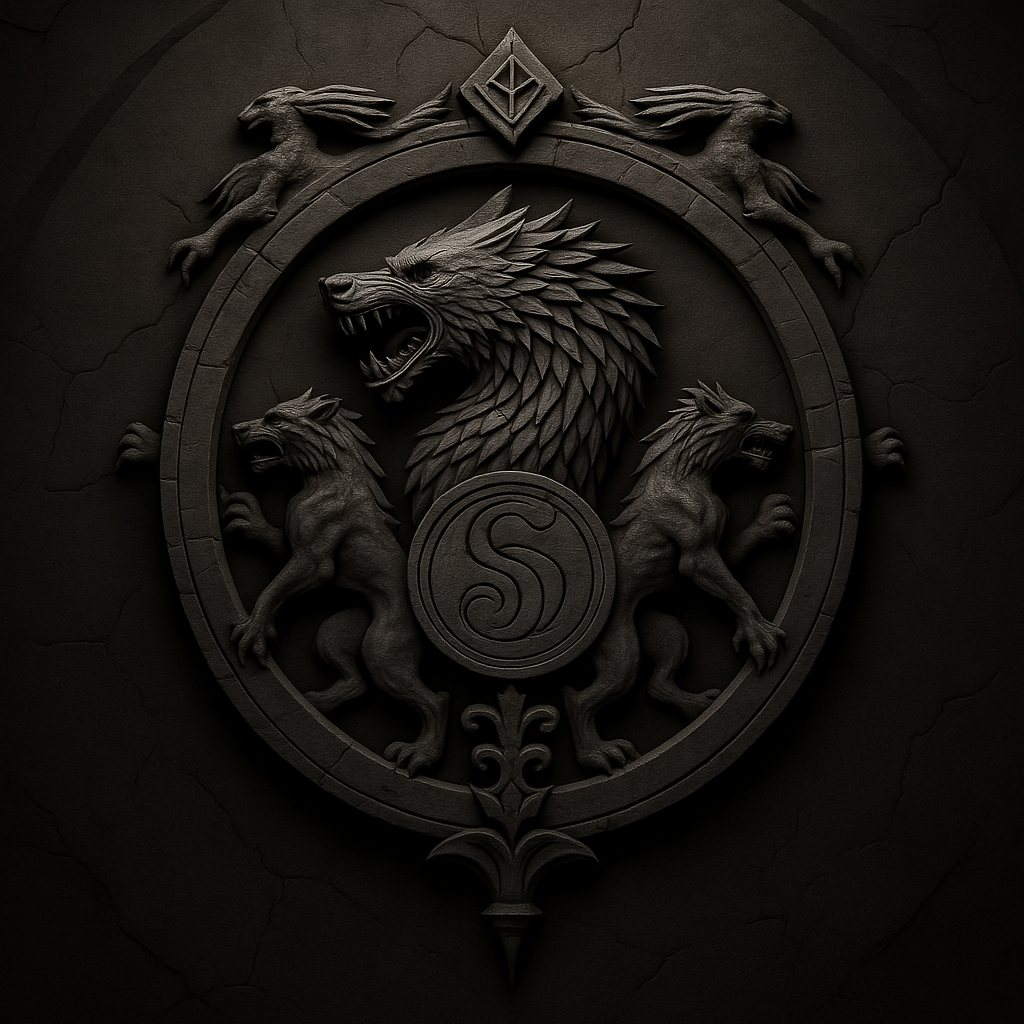
The country takes its name from its emblem, a mythical three-headed black dog called a Cerberus. Gold thread traces it on the sleeves of wizards' red and black robes.
Its uncertain frontiers release monsters: ogres, trolls, and especially giants whose resilience often defies spells. There are too few mages to cover the territory, and the State cannot defend further expansion. An adult White Dragon or Red Dragon is not a combat encounter but a political event.
This danger created a martial culture unknown in the Ark. The Knights of Cerberus ride the Cerberus horse, a black beast larger, stronger, and braver than any horse elsewhere. It breeds only on the island's plains, where the grass gives it its size. Knights and mages together drove back the ogres and giants. The horse became the country's first export long before magic; an adult can survive a Brazzant winter.
Beneath the island opens the Underdark, home of the drows and ingredients found nowhere else. Alchemists turn a great arachnid's gland, for example, into Spider Glue. Cerberans descend there knowing they are not alone.
The Ark is an archipelago of great islands and peninsulas—Telus Island, the Sylla and Crassus Peninsulas—surrounding the Central Ark. Each came to bear its censor's name. Its colossal waterfalls, white-marble palaces, impossible bridges, unfading roses, and singing fountains embody a civilization that believed a god would shelter it forever.
It counts four territories: the three censors' domains and the continent's marvelous central valley, rich in water and worked land. A circular aqueduct rings the valley, fed by four aqueducts, one from each territory. They carry grain, water, and the mana harvested by the Partage to the capital, which is also called Archon. There the aqueducts join into a single enormous vertical aqueduct that climbs into the cloud city where the god lives. The Ark's plumbing and the Ark's theology are the same structure.
The archipelago is closed by the Great Barrier: a curtain of water a kilometer across whose height no one has measured, standing between the Ark and the open sea. A censor opens it from a distance, and the water takes on his face for the length of the conversation. It is not the planar seal. The seal keeps out what comes from elsewhere; the barrier keeps out ships.
Brazzant is a cold island where the Ark long sent its exiles. Their descendants live in highland clans without schools or a magical system. Lamar, its main port, is a bartering settlement of huts.
Askenon is the dwarven world: several kingdoms built around great mines and, for most of history, never united. Kaz'Nakaram is strongest; Kaz'Baba holds mithril; Kaz'Valah holds gold. Traveling from Kaz'Nakaram to the Ark takes three weeks through snowy passes and rough seas.
Beyond lies a desert where Archon fought the red trolls. For that war he created Total Destruction, a spell that devastates an entire region.
Two languages matter. Humans speak Archon, named for their god—even Cerberan exiles kept the name. Dwarves speak Askenar, named for theirs.